Crude Oil, Maritime & Shipping, Refined Products, Wet Freight
April 10, 2026
Hormuz risks stall tankers despite high rates, yet reopening may flood market

By Max Lin
Editor:
HIGHLIGHTS
Iran retains control of key waterway
Rates rise but firms report no fixtures
800 trapped ships threaten to pressure rates
The US-Iran ceasefire might fail to benefit tanker owners despite rising nominal rates in Middle Eastern trades, according to some analysts, as security and legal risks loom large over transits through the Strait of Hormuz.
On April 7, US President Donald Trump said he agreed to suspend attacks on Iran's infrastructure for two weeks, conditional on Iran allowing ship traffic to return to normal at the key waterway handling 20% of global oil flows.
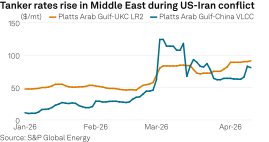
Nominal tanker rates rose following the announcement, as shipbrokers said some Asian refiners and Western traders sought tankers to load from the Persian Gulf for prompt dates.
Platts, part of S&P Global Energy, assessed the VLCC rate for shipping from the Gulf to China at $80.69/metric ton on April 10, up from $62.69/mt April 7. The LR2 clean tanker rate for the Gulf-UK/Continent trade rose to $91.11/mt from $88.89/mt.
But no firm fixtures have been reported, as tanker operators remain hesitant to send their ships into the Gulf, with Iran warning of sea mines and other security risks for ships not taking its managed routes, based on the Iranian authority's instructions.
"We are not really seeing any mainstream VLCCs just outside Hormuz willing to transit in ballast into the Gulf at the moment," Svetlana Lobaciova, Gibson Shipbrokers' principal analyst, told Platts. "The general sentiment is that owners are waiting for clarity."
Iran has yet to unveil a clear passage mechanism after some Iranian parliamentarians spoke of a $2 million toll per transit through the strait, with future Omani involvement.
Such a payment could risk US sanctions, according to ship-management company Columbia Group CEO Mark O'Neil. Sources with three major tanker companies recently told Platts that their management and compliance departments have yet to approve entry into the strait.
Hafnia and Torm, two of the world's largest tanker operators, said they do not plan to return to the Gulf in the near term amid uncertainty about security conditions.
"Unless the two-week window is quickly lengthened, I doubt there will be a large influx of ships into the Persian Gulf," BIMCO's Chief Shipping Analyst Niels Rasmussen said.
Bearish scenarios
Fotios Katsoulas, head of tanker research at S&P Global Energy CERA, said tanker rates might even face downward pressure if the ceasefire allows normal traffic to resume.
"Over 800 ships, including many VLCCs, are now expected to begin transiting out," Katsoulas said. "This sudden surge in available tonnage could temporarily weigh down spot rates as the 'trapped' supply hits the market all at once."
Katsoulas added that tanker demand from the Gulf states would not immediately return to pre-war levels, as it takes time to repair some energy infrastructure damaged during the conflict.
"Even if tankers can move, there is less refined product and crude ready to be loaded," Katsoulas said. "We expect a global supply deficit of millions of barrels per day to persist, which keeps the market in a state of high volatility."
As for war risk coverage, insurance sources said the additional war risk premium fell 0.3%-0.5% of hull value following the ceasefire from roughly 1% at end-March. This compares with the pre-war level of 0.1%-0.15%.
"It is very early days; however, underwriters are already recognizing the ceasefire and reducing rates for some risks," said Andrew James, managing director marine at brokerage Gallagher. "But they will continue to be understandably cautious as they watch how this plays out."
