Maritime & Shipping, Refined Products, Wet Freight, Fuel Oil, Bunker Fuel
February 10, 2026
Rotterdam bunker demand slips as RED boosts conventional fuel prices
HIGHLIGHTS
Dutch government's early transposition hurts port
Demand for oil-based bunker fuels shifts to nearby ports
Biobunker, LNG bunker prices appear less affected
Rotterdam is seeing its competitiveness erode as Europe's largest bunker hub amid an uneven pace of national transposition of the EU's Renewable Energy Directive III, which has hurt sales of conventional, oil-based fuels at the Dutch port, but not necessarily aided alternative fuels.
The Netherlands has implemented the bloc's flagship green energy legislation since the beginning of this year, prompting traders in Rotterdam to add compliance costs to their sale prices. However, Belgium has faced delays, while Germany has decided to exclude obligations for bunker suppliers in international trade.
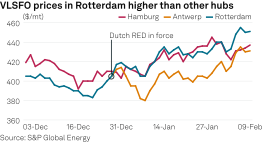
Platts, part of S&P Global Energy, last assessed the delivered bunker price for 0.5%-sulfur marine fuel oil in Rotterdam at $451/metric ton Feb. 9, a premium of $20/mt to Antwerp and $14/mt to Hamburg.
In comparison, the very low sulfur fuel oil price in Rotterdam was at parity with Antwerp and at a $14/mt discount to Hamburg Dec. 1.
Regional traders described a bunker market that has been abruptly reshaped. Throughout January, suppliers in Rotterdam repeatedly noted inquiry levels falling off sharply, with some calling activity "very poor" and "one of the worst in years."
"We saw vessels moving their stems to Belgium and Germany instead of the Netherlands, as premiums for conventional fuel were significantly lower," a Monjasa spokesperson told Platts.
Several sources cited 10%-15% year-over-year reductions in Rotterdam bunkering demand, with it shifting to other ports such as Antwerp, Hamburg, and Dunkirk.
At the same time, the fundamental market picture has been turning increasingly bearish. A trader said that with Rotterdam volumes, overall fuel prices down, and the continued slump in demand, the region would be oversupplied well into the third quarter, pushing prices lower as stocks accumulate.
When contacted, Rotterdam's port authority told Platts it had called on the Dutch government to secure uniform implementation of RED III across the EU, but that the effort was in vain.
"We regret that this has not been successful, because of which there is now no level playing field," the port authority said in an emailed statement.
Biobunker costs
Under Dutch RED III legislation, fuel suppliers are required to achieve a 2.9% reduction in the greenhouse gas emissions of their fuel pool using marine biodiesel blends derived from Annex IX-A feedstocks, such as fatty acid methyl ester, which can help them generate equivalent compliance units known as ZRE-As.
Fuel suppliers in Rotterdam can no longer meet their mandates using biofuels derived from Annex IX-B feedstocks, such as used cooking oil methyl ester, a previously popular choice among shipowners obligated under FuelEU.
The most common biobunker grades are B30, which contains 30% UCOME or Advanced FAME and 70% VLSFO.
Compared with their counterparts in Antwerp, suppliers in Rotterdam could theoretically face disadvantages in offering UCOME-based blends but advantages in Advanced FAME-based blends when covering oil components, allowing them to compensate for price differences or even compete by selling ZRE tickets.
"We are seeing ... biobunker pricing is closer to parity as the regulatory framework increasingly supports their uptake," KPI OceanConnect's global head of alternative fuels, Jesper Soerensen, told Platts. "These premiums are offset by ERE, the Dutch carbon emissions reduction model, making bio prices competitive with Antwerp."
"Under this legislation, it's going to be IX-B feedstocks in Antwerp, whereas in Rotterdam, it's going to be IX-A feedstocks -- the differential is about $100/mt because of the feedstock difference [allows IX-A blends to sell at lower prices due to ZRE income]," a UK-based trader said.
Platts last assessed the current-year ZRE-A price at 15.5 euro cent/kilogram of CO2 equivalent Feb. 9.
Market participants have widely said, however, that demand so far this year has remained lackluster, likely because shipowners lack clarity on their compliance balances under FuelEU, pending final verification until March 31.
LNG
While LNG bunker suppliers, on paper, would face higher compliance costs in Rotterdam and bio-LNG subsidized under RED III, market participants have yet to see much impact due to their trade patterns.
At the moment, sources have noted a healthy demand for both products across the Amsterdam-Rotterdam-Antwerp region.
"Things are busy on the spot market in ARA lately," an Atlantic-based trader said. "LNG is largely gas index-linked, local supply and demand availability of bunker vessels, contract demand versus spot, rather than short-term regulation arbitrage."
Platts last assessed the Rotterdam and Barcelona LNG bunker fuel prices at $14.012/million British thermal unit and $14.714/MMBtu, respectively, Feb. 9.
