Refined Products, Crude Oil, Maritime & Shipping, Diesel-Gasoil, Gasoline, Jet Fuel
November 12, 2026
Thin refining buffers expose jet fuel to fresh price spikes in 2027
By Mia Pei
Editor:
HIGHLIGHTS
Low inventories heighten supply risks
Diesel demand squeezes jet fuel output
Asian refining shift lengthens trade routes
Jet fuel markets face renewed price spikes in 2027 as depleted inventories and limited spare refining capacity leave supply vulnerable to disruptions, panelists said at the IATA Aviation Energy Forum in Guangzhou Nov. 11.
While there were reasons for near-term optimism, the market could tighten again next year without an easing of disruptions involving the Middle East and Russia, said Rob McLeod, global head of commodity risk solutions at Hartree Partners.
"We've drawn down to exceptionally low inventory levels," McLeod said. "Absent those possibilities, we've got these huge risks with very little buffer."
A US Gulf Coast hurricane, for example, could expose the lack of a refining buffer and trigger renewed price spikes, he said. "There's a lot of cause for concern about potential spikes next year."
The warning comes after global jet fuel stocks continued edging lower in October as demand outstripped supply, with refiners focused on maximizing diesel yields, according to S&P Global Energy CERA's November outlook. The global jet fuel crack averaged $72/b in September and is forecast to strengthen to $74/b in the fourth quarter, then ease to $51/b in the first quarter of 2027 and $40/b in the second quarter.
That expected easing nevertheless comes as underlying aviation demand strengthens. CERA sees global jet fuel demand rebounding by 1.17 million b/d in 2027, following a 255,000 b/d decline in 2026.
James Simpson, global head of aviation research at S&P Global Energy, also warned that jet fuel markets would remain exposed to volatility.
"I don't think the world is going to ease into a calmer place next year," Simpson said.
Refining availability has become a more important constraint on jet fuel supply than crude production, McLeod said, with crude supply comparatively more comfortable than refining availability this year. "Nowadays really refining is the key constraint," he said.
Diesel competition
Jet fuel's outlook remains closely tied to diesel, with shortages in the larger middle distillate market feeding into aviation fuel availability and pricing, Simpson said.
"The diesel's tightness is going to continue to drive jet tightness," he said.
S&P Global Energy's November outlook put diesel markets as "very tight," amid sharply reduced Middle Eastern exports and a prolonged Russian diesel export ban. The tightness has encouraged refiners to optimize diesel yields even as jet fuel inventories and exports decline.
In Asia, that competition is particularly visible ahead of winter. Singapore jet/kerosene cracks against Dubai strengthened $10.4/b to $66.2/b, while the jet-diesel regrade discount widened to $8.3/b in October, according to CERA's Asia outlook. Asian cracks are expected to remain elevated in November and December amid winter heating oil demand and tight middle distillates markets.
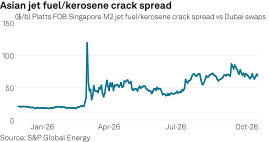
Platts, part of S&P Global Energy, assessed the FOB Singapore jet fuel/kerosene crack against Dubai crude at $59.55/b Nov. 11.
Over the longer term, electrification could reduce gasoline demand and encourage refinery closures even as aviation fuel consumption continues to grow, Simpson said. Diesel consumption from trucking, mining and agriculture is also likely to prove more resilient than gasoline demand.
"If you're knocking out demand for gasoline down the line, you're going to have less refining," he said. That would leave a smaller refining base facing competing requirements for middle distillates, increasing pressure on refiners to choose which products to produce, he added.
The lack of spare capacity also limits the industry's ability to replace lost production during outages, Simpson noted.
However, proximity to refining capacity alone does not guarantee secure supply, McLeod said. Outages and export restrictions can still disrupt availability, making diversification of supply sources important.
Longer supply chains
The shift in refining capacity toward Asia and the Middle East is also increasing importing regions' exposure to longer supply chains, freight costs and geopolitical disruptions, the speakers said.
Simpson cited jet fuel shipments from South Korea to Europe as an example of the distances required to meet European demand.
McLeod said the spread between Northwest European and Singapore jet fuel benchmarks had widened in recent months, reflecting higher freight costs and Europe's import dependence.
Platts assessed the spread between jet fuel/kerosene CIF Northwest Europe cargoes and FOB Singapore jet fuel/kerosene at plus $30.33/b Nov. 11, up from plus $26.10/b the day prior.
For Australian carriers purchasing fuel priced against Singapore benchmarks, the freight component also creates exposure that must be managed, whether borne directly by the airline or incorporated into a supplier's premium, he said.
Simpson cautioned that freight increases were smaller than swings in jet fuel cracks, although the two costs compounded the burden for import-dependent buyers.
Energy-security concerns could temper the pace of European refinery closures, Simpson said, while McLeod pointed to both strong refining profitability and the possibility of policy support.
Still, retaining local capacity would not eliminate disruption risks, the speakers said, with diversified sources and spare refining capacity offering additional protection.
