


Refined Products, Maritime & Shipping, Fuel Oil, Bunker Fuel
May 06, 2026
Sri Lanka bunker fuel demand falls on barge shortage, tight credit
Editor:
HIGHLIGHTS
Sri Lanka bunker demand falls 25% in April
Barge shortages, tight credit limit sales: sources
MGO demand rises on competitive pricing
Demand for bunker fuels at Sri Lankan ports fell in April due to issues with barge availability, according to multiple market sources. Low inquiries, tighter credit and cautious risk exposure kept activity subdued in April, with May driven mainly by earlier contracts.
Sri Lanka demand declines
Demand for bunker fuel has weakened in April for Colombo, Trincomalee and Hambantota ports, market participants said.
"In Sri Lanka, April volumes were lower than March as we saw a noticeable drop in demand, likely due to tanker repositioning. Bunker inquiries volumes in March were around 300,000 metric tons, but fell sharply to about 100,000 mt in April," a Colombo-based supplier told Platts, part of S&P Global Energy.
"Final secured volumes were about 25% lower month over month across all three bunker grades. On average, we were fixing around 1,800 mt of very low sulfur fuel oil in April across Colombo and Hambantota. Product availability in India was relatively strong, so part of the demand likely shifted there," the supplier said.
"In March, demand was very strong during the first two-three weeks. Barges were tight, but we still managed to supply them; the only real constraint was the availability of barges. Overall, the Sri Lankan market reached about 118,000 mt in March, which could have been higher if barge capacity was not tight," the supplier added.
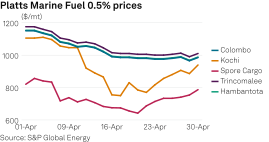
Platts assessed marine fuel oil 0.5% delivered to Colombo at $970/metric ton May 5, down $10/mt from the start of the week. Marine fuel oil 0.5% delivered to Trincomalee was assessed at $995/mt, down $10/mt from the start of the week.
"On the credit side, high bunker prices triggered tightening of credit lines from our suppliers, which in turn forced us to reduce our own exposure. In April, we revised credit terms from 30 days to 14 days, and in some cases, down to seven days," another supplier said.
"For certain customers, we stopped extending credit altogether. Given the ongoing conflict, we also assessed counterparty risk more closely due to the possibility of financial distress among some participants. We are now extending credit only to established bunker trading houses and reputable shipowners to mitigate risk. As in May, we are primarily delivering contracts fixed in April, while fresh sales activity remains relatively subdued," the second supplier added.
Bunker price stabilizes in April
"In April, the situation in Sri Lanka normalized compared to March, when we faced challenges with product availability and weak demand. However, demand in April has also not been robust," a third Sri Lanka-based supplier said, adding, "demand for VLSFO has fallen amid the recent war situation and prices are now declining."
"Lanka IOC PLC at Port Trincomalee supplied nearly 6,000 mt, and in Colombo, we supplied 7,000 mt. Most of the demand has been driven by LNG carriers and bulk carriers," the third supplier said.
"On a positive note, we have seen strong demand for marine gasoil for April, which is priced $200-$300 cheaper than in India. We faced some barge-tightness issues at the port, but conditions were normal at the outer port limit," the third supplier said. "Looking ahead to May, we anticipate strong volumes."
MGO demand driven by competitive pricing
"In April, the volume has declined by at least 15,000 mt month over month. The market performed in a normal manner," a Sri Lanka-based trader said. "The average stem size for VLSFO was observed to be between 500-600 mt, with most of the demand driven by bulk carriers and container ships in Colombo."
"We also saw solid demand for MGO, with the average stem size supplied ranging from 260-270 mt. The increase in MGO demand can be attributed to competitive pricing, as our offers are significantly lower than those from India and Fujairah," the trader said.
"On the operational side, there is a barge-tightness issue: the lead time for barge deliveries is one week prior to placing an inquiry. There is a total of six barges positioned in Colombo and one each in Trincomalee and Hambantota," the trader added.
HSFO demand declines
According to market sources, demand for high sulfur fuel oil at Sri Lankan ports weakened in April amid good product availability in the region.
"In recent times, we have not observed any demand for HSFO, supplying about 15,000-18,000 mt of volume in Colombo. On the operational side, we currently lack storage tanks for HSFO at the ports, so whenever we get an inquiry, we directly load the cargo and supply to the vessel," another trader said.
Platts assessed the average price of Bunker FO 380 CST delivered to Colombo for April at $942.16/mt April 1, down $57.33/mt month over month. In Kochi, Platts assessed the average price of Bunker FO 380 CST delivered at $644.57/mt, down $7.02/mt over the same period.
