Refined Products, Jet Fuel
May 05, 2026
USWC distillates trade flows shift on Asia-Pacific supply crunch
By Benjamin Peyton and Carlos Castillo
Editor:
HIGHLIGHTS
USWC exports first cargoes to Australia since October 2020
Jones Act waiver cargoes from USGC arrive in Alaska
California jet fuel imports drop 45% amid conflict
Distillates flows are shifting at the import-dependent West Coast, including exports to Australia and Jones Act Waiver-compliant shipments from the Gulf Coast as Asia Pacific liquidity thins during the US-Israel war with Iran.
Exports surface
The Medium Range Betelgeuse discharged around 337,000 barrels of distillates fuel at Brisbane, Australia, where BP's Bulwer Island Refinery is located, according to a US jet trader who noted the cargo included jet fuel.
The tanker loaded at BP's 238,500 b/d refinery near Cherry Point, Washington, around March 30, according to S&P Global Commodities at Sea data.
Three other cargoes in the amount of 1.324 million barrels of distillate fuels have been loaded for export to Australia from Cherry Point since March 24, marking the first wave of exports to the country from the USWC since October 2020.
USWC exports to the Philippines and Japan could surface next, particularly military-specification jet and ULSD, a US jet trader said on April 28. The last USWC exports to respective countries were in February 2023 and June 2024, according to CAS data.
Jones Act waiver
USWC supply drew support from the Jones Act waiver, as a string of rare shipments from the US Gulf Coast have surfaced since March. The 60-day waiver issued March 18 lifts the restriction that requires all ships moving goods between US ports to be US-built, US-owned and US-crewed.
The Medium Range tanker STI Mystery loaded 110,000 barrels of jet at the Port of South Louisiana on April 1, passed through the Panama Canal, and discharged at Nikiski, Alaska, on April 27, according to CAS data.
Additionally, the MR Torm Daphne loaded at Houston on April 5 followed a similar voyage and discharged 313,000 barrels of distillates at Anchorage, Alaska, on May 2.
Refined Products flows from the US Gulf Coast to the USWC since the conflict broke out are up by nearly 59% year over year at 4.116 million barrels as of May 4.
At least 13 international-flagged vessels and one US vessel have made the voyage from the USGC to the USWC since Feb. 27. Over the same period last year, four foreign vessels and five domestic tankers took a similar voyage.
California supplies pressured
Jet imports to the USWC, including Sustainable Aviation Fuel, are down almost 37% year over year since the US-Israel war with Iran, according to US Customs Data, with Hawaii being the only state to increase its foreign supply by less than 2%, while Oregon and Washington imports have stopped.
California imports are down by nearly 45% and, in Alaska, deliveries are down by over 21%
California, Hawaii and Alaska have imported the most supply in the region, accounting for over 38%, more than 35% and nearly 27%, respectively.
South Korea is providing 85% of imported supply from about 83% in the same period last year. Japan, China and Singapore accounted for the remainder of supply since Feb. 27.
USWC inventories dip
Jet fuel stocks in California rose by 341,000 barrels to 2.983 million barrels in the week to April 24, the California Energy Commission said April 30, as output rose by 17,000 b/d to 323,000 b/d at the same time.
CARB ULSD output rose by 90,000 b/d to 840,000 b/d, but inventories fell by 128,000 barrels to 1.417 million barrels.
EPA ULSD production fell by 101,000 b/d to 483,000 b/d, dropping inventories by 32,000 barrels to 1.061 million barrels.
USWC jet stocks fell to 10.644 million barrels in the week to April 24, the US Energy Information Administration said April 29, which is the lowest level since May 9, 2025.
ULSD stocks in the region fell to 9.443 million barrels at the same time—an 11-month low.
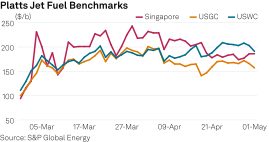
In line with reduced imports and falling stocks in the region, Platts assessed the US West Coast jet outright price for Los Angeles pipeline on May 4, up 5.18 cents/gal to $4.5982/gal, marking a rebound from the previous close, which had been near a two-week low.
However, the USWC jet differential for the LA pipeline declined by 7.50 cents/gal, closing at NYMEX June ULSD futures plus 52.50 cents/gal.
In the diesel market, the California Air Resources Board spec ULSD outright price surged by 17.68 cents/gal to $4.2532 per gallon, recovering from the previous session's lower close.
Platts is a part of S&P Global Energy