


Crude Oil, Refined Products, Maritime & Shipping, Fuel Oil, Bunker Fuel
April 27, 2026
Atlantic demand could support VLCC rates despite oversupply worries: CMES
Editor:
HIGHLIGHTS
Hormuz disruption raises oversupply concerns
CMES Q1 VLCC profit rises 410.5% on year
Rising demand from the Atlantic Basin may support VLCC freight rates despite growing concerns about a structural oversupply in the tanker market amid trade disruptions through the Strait of Hormuz, China Merchants Energy Shipping said April 27.
CMES's Secretary of the Board of Directors, Kong Kang, said during an investor question-and-answer session that recent fears of "no oil to move" are overstated as rates on some long-haul routes begin to stabilize.
"We have seen views saying there is 'no oil to transport,' and spot freight outside the Gulf has corrected," said Kong. "Personally, I believe this is mainly a short-term mismatch between vessel/cargo, and not something to worry excessively about. Recently, there have been signs that this effect is weakening, such as Atlantic long-haul freight stabilizing."
CMES is one of the world's largest VLCC owners and is backed by the Chinese government.
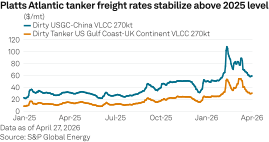
Platts, part of S&P Global Energy, assessed the dirty US Gulf Coast-China VLCC 270,000 metric ton route at $59.26/mt on April 24, down from the postwar peak of $108.52/mt on March 4 and below Feb. 27's $65.19/mt. The price remains 74% higher than 2025's average of $34.01/mt.
Platts assessed the dirty USGC-UK Continent VLCC 270,000 mt route at $30.56/mt on April 24, down from a record high of $54.63/mt on March 27 and below the Feb. 27 level of $32.41/mt. The price is more than double the 2025 average of $15.07/mt.
Disruption strategy
Kong's comments come as the number of daily ship transits through the Strait of Hormuz collapsed following the start of the war in the Middle East on Feb. 28.
Prolonged disruptions through Hormuz -- which handles 20% of global oil trades in normal times -- could create a more bearish structural outcome for tanker markets, according to Kong.
"If Hormuz were closed for a long time, short-term oil and gas supply gaps would be difficult to fill; the world could fall into a phased energy crisis and structural VLCC oversupply is possible," he said, when asked about the VLCC sector's outlook amid the Middle East conflict.
If normal transit through Hormuz resumes, an initial rush to move delayed crude cargoes may emerge, although freight levels would depend on vessel availability, cargo demand and market sentiment at that time, according to Kong.
"Since the current VLCC market supply and demand exceeded the equilibrium point, the impact of that inventory replenishment demand [after normal Hormuz transit resumes] will depend on the marginal changes to supply and demand," he said.
CMES maintains an international operations strategy that deploys capacity flexibly, according to Kong.
Wang Yongxin, managing director, CMES, highlighted the company's capacity redeployment to capture the rising US Gulf tonne-mile demand: "Since mid-April, the main impact on the company's VLCC business from the Hormuz situation has been increasing vessel positioning toward South America and the US Gulf."
Wang said that while the situation has slightly lowered CMES's operating utilization, the company's time charter equivalent earnings have risen quarter over quarter, "laying a solid foundation for second-quarter results."
CMES's Q1 results showed that year‑over‑year tanker operating days declined, with VLCCs down 2% and Aframax vessels down 17%. However, capacity deployment remained active, long-haul routes expanded and cargo turnover increased, with VLCCs up 13.51% and Aframax vessels up 36%.
Net profit in the VLCC segment reached Yuan 2.49 billion during the period, representing a year‑over‑year increase of 410.5%, according to the company's release.
