Crude Oil, Maritime & Shipping
April 24, 2026
Trump extends Jones Act waiver to ease fuel costs amid Iran war

Editor:
HIGHLIGHTS
White House says move allows increased supply
West Coast jet fuel prices hit record highs
The US government extended a Jones Act waiver by 90 days, a White House spokesperson confirmed April 24, as the Trump administration continued its efforts to contain energy costs amid its ongoing conflict with Iran.
The extension will begin at 12 am ET on May 18, pushing the expiration of the Trump administration's initial 60-day waiver to mid-August from May 17, the White House confirmed to Platts, part of S&P Global Energy.
The decision was announced early to "allow ample time for the maritime industry to ensure there are sufficient vessels available to continue moving the applicable commodities to the point of need," the White House said. On March 18, the White House acknowledged that the waiver was designed to "mitigate the short-term disruptions to the oil market" resulting from the US-Israel war on Iran and the significant decrease in shipping traffic through the Strait of Hormuz.
"New data compiled since the initial waiver was issued revealed that significantly more supply was able to reach US ports faster," Trump administration spokesperson Taylor Rogers said in a statement on X. "The waiver extension provides both certainty and stability for the US and global economies."
Political stakes
The Jones Act, formally Section 20 of the Merchant Marine Act of 1920, requires that any goods shipped by water between two US ports be carried on ships that are US-built, US-owned, US-flagged and US-crewed. Suspending the law allows foreign-flagged ships to transport products between US ports.
A limited supply of Jones Act-compliant ships is available to transport crude oil from the US Gulf Coast to coastal refineries in other regions that typically source imported barrels transported on cheaper, non-US tankers. The US Gulf Coast regularly exports crude and refined products to international markets.
The Jones Act, originally designed to promote US shipbuilding, has long been controversial among US companies, which have criticized it for reducing the available vessel fleet and raising transportation costs.
Waivers are rare and have typically drawn harsh political pushback from US maritime groups. The last waiver was issued in 2022, when the Biden administration suspended the law for a single BP tanker. The American Maritime Partnership responded at the time that its members were "shocked and outraged."
In a statement, AMP President Jennifer called the current waiver "historically long and ineffective" and the administration's latest extension "an affront to hundreds of thousands of hardworking Americans who put this country first every day."
US West Coast impact
Jones Act compliance has long made most refined product bookings to domestic ports from tankers originating on the US Gulf Coast economically unviable.
Most compliant flows of fuel products have traditionally supplied Florida, which has no refineries and does not connect to the large Colonial or Products pipelines that supply much of the East Coast, according to a March 16 S&P Global Energy CERA report.
Analysts and market participants have consistently downplayed the impact of the Jones Act waiver on domestically produced US Atlantic Coast-bound crude and refined products. The disruption of cargoes from Middle East producers to Asian refiners has dramatically increased refined prices on the US West Coast, however. USWC jet fuel differential and outright prices hit record highs on April 23, Platts assessments found.
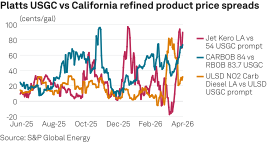
South Korea, which has had to source alternative crude barrels since the outbreak of the war, supplied 82% of jet imports to the USWC in 2025. Since the administration's initial Jones Act waiver, rare crude shipments from the US Gulf Coast have surfaced, according to S&P Global Commodities at Sea data. Two foreign-flagged tankers have been seen loaded in the USGC for voyages through the Panama Canal and on to the USWC, CAS data showed.
California's shift to a waterborne refined products import model -- following the closures of Phillips 66's Wilmington facility and Valero's Benicia refinery in recent months -- has come under particular strain amid the disruptions from the Middle East.
On April 23, Kinder Morgan CEO Kimberly Allen Dang said the company -- alongside Phillips 66 -- was moving toward a final investment decision on the proposed Western Gateway pipeline system. The line would reduce California and Arizona's reliance on waterborne imports by providing access to domestic supply from Texas and the Eastern US, Dang said.
