


Maritime & Shipping, Wet Freight
April 08, 2026
INTERVIEW: Hafnia sees Middle East war reshaping tanker trade, but decarbonization targets stay intact

By Mia Pei
Editor:
HIGHLIGHTS
LR2 segment shifts to dirty
Hafnia maintains 40% carbon cut target by 2028
Bio-bunker adoption needs policy clarity
The Middle East war has sharply altered product tanker trade flows and intensified the industry's focus on energy security, Pankaj Porwal, Hafnia's general manager of project and fleet sustainability, told Platts, part of S&P Global Energy.
"The geopolitics of the past few weeks have changed things drastically," Porwal said in an interview during Asia Pacific Maritime 2026.
He said product flows were increasingly moving from west to east, with the US Gulf exporting more cargoes into Asia, while East Asian countries, including Japan and China, were curbing product exports due to supply concerns.
Porwal said the shift had supported freight markets, with more ships ballasting west and returning east laden. He also flagged a notable shift in the LR2 segment from clean to dirty petroleum products, warning that if CPP demand rebounds quickly, vessel availability for clean cargoes could tighten because tonnage does not switch back immediately.
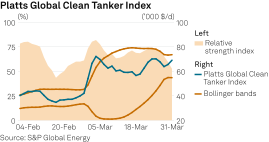
The Bollinger bands on the Platts Global Clean Tanker Index widened spectacularly in early March, surging past $55,000/day, compared to the previous month's spread of below $13,000/day. This volatility reflects the acute scarcity of clean tonnage and the structural mismatch between supply and demand.
Decarbonization on track
The real tension now is that "survival and energy security" are taking priority as the conflict disrupts trade, fuel supply, and crew safety, said Porwal.
Still, he said the current market volatility does not amount to Hafnia's retreat from decarbonization.
"As far as Hafnia is concerned, I do not see any changes in our targets and objectives from an environmental point of view," he said.
The company is targeting a 40% reduction in carbon fleet intensity by 2028 from a 2008 baseline, ahead of the IMO's 2030 target, and net-zero scope 1 emissions by 2050.
Regarding marine fuels, Porwal said the company had lifted biofuel in both Singapore and Europe after detailed risk assessments, but that European regulation had been the main driver of demand.
He said biofuel economics remain challenging without policy support, as biofuels' lower energy content means more is needed to match the output of conventional bunkers, so they should trade at a discount rather than a premium. While biofuels are currently priced at a lower premium or even a discount to fossil fuels due to market volatility, he said this is mainly because geopolitical disruptions have driven up fossil fuel prices, not because biofuel fundamentals have improved.
Platts assessed Biobunkers B30 UCOME Rotterdam Premium below $200/mt in early March, rebounding to $378.25/mt by April 7.
Wider adoption challenges
For broader low-carbon fuel adoption, Porwal said that economics are essential, alongside policy clarity and fuel availability.
"There has to be a clear policy which is driving uptake," he said, adding that fragmented regional rules left shipowners uncertain over where and why they should use more expensive low-carbon fuels. "If I can't get it, I can't wait, because we are carrying cargo."
He pointed to the EU's emissions rules as an example of how clear regulation can drive compliance, and added that shipping's decarbonization path could not be built "in a silo," because fuel suppliers, engine makers, shipyards, owners, operators, and charterers all needed aligned signals.
Porwal said that while Singapore was doing its part by expanding supply readiness for multiple future fuels, uptake would still depend more on regulatory alignment than on local infrastructure alone.
Looking ahead, he said the next major signal for shipping decarbonization would be whether policymakers, especially at the IMO level, can provide clearer direction on future-fuel pathways and compliance expectations. Without that clarity, he said, shipowners risk ordering vessels designed for fuels that may not be available on a scale when the ships are delivered.
"If you keep delaying decisions or do not give clarity on what is expected from shipowners, operators, or shipyards, it becomes a very dicey situation," said Porwal.
