Refined Products, Maritime & Shipping, Fuel Oil, Bunker Fuel
April 07, 2026
Singapore bunker demand rises 13% in March on higher vessel activity: CAS
Editor:
HIGHLIGHTS
Ships turn to bunker hub amid Middle East disruption
Bunkering events increase to 9,355 vessels
Premiums surge erodes inventory incentives
Singapore's bunker fuel demand grew by double digits year over year in March, according to S&P Global Commodities at Sea data April 6, as more shipping companies turned to the world's largest marine refueling hub amid disruption in the Middle East.
Total bunker sales in March were estimated to be 4.99 million metric tons, up 12.6% year over year, according to CAS figures. Sales were also 8.2% higher than February, when demand was softer due to fewer days in the month and holiday-related slowdowns
With the war in the Middle East preventing most shipping from transiting the Strait of Hormuz, Singapore's position along the Strait of Malacca shipping corridor allows the port to serve as a waiting area or operational hub for ships adjusting voyage plans.
Bunker activities gradually normalized over the month despite fears of a supply shortage. Nonetheless, some market participants expect overall bunkering volumes to fall later as tanker owners ballast west amid limited cargo opportunities in the East and Middle East.
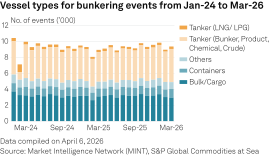
The total number of bunkering events rose to 9,355 in March, up from 8,951 in February, reflecting a broad-based pickup in vessel traffic following the Lunar New Year holidays, CAS data showed.
Bulk carriers accounted for the largest share of bunkering demand, with 2,630 vessels refueling in March, though easing from February's 2,716. It was followed by container ships, up from February's 941 to 1,059 in March, and chemical/product tankers, up from 1,279 to 1,450, highlighting continued strength in dry bulk and liner trades.
Crude oil tankers registered 962 bunkering events in the month, up from 858 events in February. Product tankers registered 981 bunkering events, up from 893 in the previous month.
By fuel type, low sulfur fuel oil retained the largest share at 2.46 million mt (49.5%), followed by high sulfur fuel oil at 2.12 million mt (42.5%), while marine gasoil accounted for 400,000 mt (8%).
The relatively high HSFO share reflects sustained demand from scrubber-fitted vessels, while LSFO demand continues to anchor overall bunker consumption, based on the report.
The report estimated total bunker consumption, comprising LSFO, HSFO and MGO, at 4.99 million mt in March, up from the official 4.6 million mt in February and from 4.43 million mt in the corresponding month of 2025. The latest CAS data includes biofuels in both HSFO and LSFO, with LSFO also comprising ultra low sulfur fuel oil (ULSFO). B100 volumes are excluded.
The bunker demand rebound coincided with a drawdown in heavy distillate stocks in the week ended April 1, after registering a 10-week high in the previous week, as inflows from Asia and the Middle East declined. Singapore's commercial stocks of heavy distillates fell to a four-week low of 23.47 million, down 4.3% over the week but 10.8% higher than the corresponding week in 2025.
Premiums surge
Singapore-based market participants noted that a combination of backwardation and volatility had eroded traders' incentives to hold inventory.
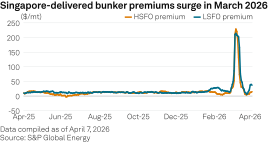
Platts, part of S&P Global Energy, assessed Singapore-delivered 0.5%S bunker premiums against the benchmark FOB Singapore 0.5%S marine fuel cargo averaged $78.49/mt in March, up from February's $21.40/mt.
The Singapore-delivered HSFO bunker premium against the benchmark FOB Singapore 380 CST cargo averaged $63.86/mt in March, compared with $8.53/mt in February.
"The price spread is too wide ... people are reluctant to hold cargo -- you buy today, it could be cheaper tomorrow," said a Singapore-based market participant, noting several traders had reduced tankage or scaled back working inventory.
This effectively tightened bunker availability, even as overall supply seemed sufficient, one bunker trader said.
Ang Wee Keong, the chief executive of the Maritime and Port Authority of Singapore, said in a speech on March 25: "The flow of goods through Singapore has remained stable in recent weeks, and there is adequate bunker supply to meet the industry's demand."
This followed an MPA statement on March 13 highlighting adequate bunker supply to meet demand, and that it has "not observed any significant changes to ship arrival schedules in the Port of Singapore."
