Maritime & Shipping, Refined Products, Wet Freight, Fuel Oil, Bunker Fuel
April 06, 2026
India bunker fuel demand surges on Hormuz disruption, rerouting
Editor:
HIGHLIGHTS
Kandla volumes reach 58,000 mt in March
East coast ports face supply constraints
Demand for bunker fuel at India's west coast ports was strong in March, with solid volumes reported at Kandla and Mumbai. Kochi also experienced a rise in inquiries, and east coast ports saw robust demand with limited product availability.
Traders and suppliers reported strong demand and ample availability of very low sulfur fuel oil in the region in March for Mumbai port, supported by an increase in foreign vessels calling, likely due to the Strait of Hormuz disruption.
"We have seen good demand for high-flash high-sulfur diesel in Mumbai, where the overall volume is about 5,000 mt, with a good number of inquiries seen in the region," an India-based supplier said.
A Gujarat-based trader said: "Demand in Kandla strengthened from March 5, supported by increased vessel rerouting activity toward the Gulf of Kutch, and remained firm through March 29. However, barge availability was tight amid heavy vessel traffic, with all six barges in the region fully occupied, resulting in extended lead times of around 10-15 days from the date of inquiry."
"Since the onset of the war and the closure of the Strait of Hormuz, demand has shifted significantly toward Kandla," a supplier based at the port told Platts, part of S&P Global Energy. "By the first week of March, total volumes for very low sulfur fuel oil had reached around 37,000 mt. Overall volumes for March are estimated at about 58,000 mt across both VLSFO and high sulfur fuel oil, with product availability remaining strong and no production constraints."
"We expect demand momentum to continue into April, with total volumes projected at around 60,000-65,000 mt across the region," the supplier added.
Kandla port completed the first methanol bunkering trial in India April 3.
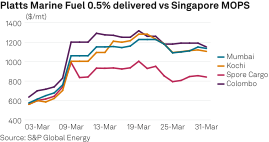
Platts assessed marine fuel oil 0.5% delivered to Mumbai at $1,119/mt April 6, down $16/mt from the start of the week. Marine fuel oil 0.5% delivered to Colombo was assessed at $1,134/mt, down $16/mt from the start of the week, while marine fuel oil 0.5% delivered to Kochi was assessed at $1,110/mt, up $5/mt over the same period.
Kochi sees strong demand in March
"We observed strong demand in March, with steady inquiries from traders throughout most of the month," a Kochi-based supplier told Platts. "Demand was primarily driven by crude tankers and container vessels, including those operated by MSC, although activity softened slightly after March 20."
"Overall, Bharat Petroleum Corp. Ltd. supplied close to 10,000 mt of very low sulfur fuel oil in Kochi during the month," the supplier added.
"Demand for high sulfur fuel oil in Kochi has been strong; however, no volumes have been seen due to tight product availability. "We have not seen any inquiries for marine gasoil, likely due to elevated prices, and demand is expected to remain subdued in the near term."
"The Indian government imposed a tax on MGO for bonded vessels, which could further dampen demand," a local supplier said. "Additionally, following the excise duty imposed on high-flash high-speed diesel from March 26, buyer costs have increased by about $100/mt compared with previous market levels, making marine gasoil procurement at Indian ports more expensive."
East coast India supply constraints
Ports along India's east coast experienced strong demand in March, with Chennai recording a strong rise in volumes and Haldia recording stable volumes. However, Visakhapatnam and Paradip saw strong demand but struggled with supply and operational issues, traders, suppliers and barge operators said.
"Supply and demand remained largely stable throughout the month, although a weeklong pipeline maintenance issue in the third week of March temporarily disrupted operations," a Paradip-based supplier told Platts. "Overall, volumes handled stood at around 5,000 mt, with vessel traffic declining compared with previous months, while broader market conditions remained steady."
"We expect volumes to increase to around 8,000 mt at Paradip in April," the supplier added.
"In March, demand for very low sulfur fuel oil in Haldia remained strong, supported by a high volume of inquiries and adequate product availability, with no significant supply constraints," a Visakhapatnam-based supplier told Platts. "Indian Oil Corp.'s Haldia refinery supplied over 14,000 mt during the month, although some tightness was observed in barge availability across the region," the supplier added.
"At Chennai, demand strengthened in March, supported by product shortages at other ports," a Visakhapatnam-based supplier told Platts. "Volumes rose from around 6,000 mt to about 12,000 mt compared with previous months."
"In Tuticorin, however, demand was present, but supply remained constrained due to inconsistent product availability and limited barge access, with total volumes reaching only around 4,000 mt in March, largely met through truck deliveries," the supplier added.
A local supplier said: "Demand at Visakhapatnam remained strong in March; however, product supply for commercial vessels was constrained as priority was given to government-owned vessels. Hindustan Petroleum Corp. Ltd. supplied about 12,000-13,000 mt during the month, while demand for high sulfur fuel oil was estimated at about 4,000 mt."
