Crude Oil, Maritime & Shipping, Wet Freight
March 31, 2026
INTERVIEW: Human life concerns prevent Hormuz transits, says Columbia CEO

By Max Lin
Editor:
HIGHLIGHTS
Safety of seafarers, cargo and ships take priority
Iran limits access to Hormuz to small number of ships
Crew changes still take place, essential goods available
Maritime traffic via the Strait of Hormuz has largely halted since the US-Iran war broke out mainly because of vessel operators' concerns for seafarers' lives, ship-management company Columbia Group CEO Mark O'Neil said in an interview.
The UN's International Maritime Organization recorded at least one yard worker and six seafarers died during the military conflicts, with Iranian navy forces seeking to disrupt ship operations in retaliation against US and Israeli attacks.
While traders will weigh oil prices against freight rates and insurance premiums before deciding whether to move a cargo, O'Neil attributed the shipping industry's reluctance to use the key chokepoint with 20% of global oil flows to safety worries.
"The overriding concerns at the moment, quite rightly, by any self-respecting owner or cargo interest or commodity owner, is the safety of human life, and that must be put right at the top," O'Neil told Platts March 27.
"Obviously, there is the safety of the ship asset as well and the safety of the cargo."
Based on standard charter terms, shipowners have the legal right to refuse a charterer's instruction if they deem the voyage too dangerous. Seafarers also hold the right to refuse to sail into high-risk areas like Hormuz in general employment contracts, according to the International Transport Workers' Federation.
O'Neil said a Hormuz transit would only occur when the involved parties can minimize safety risks, additional insurance is obtained, and the crew are willing to accept heightened risks in exchange for compensation.
Those will come before commercial considerations, according to O'Neil.
The Platts Dubai crude benchmark was assessed at $121.10/b on March 31, more than 70% higher than the pre-war level of around $70/b. The VLCC rate for the Persian Gulf-China trade was at $64.14/metric ton, compared with $46.04/mt on Feb. 27, the day before the war began.
The additional war risk premium for moving tankers across the Persian Gulf was around 1% of hull value in the week ended March 27, multiple maritime insurance executives said. The pre-war level was 0.10%-0.15%.
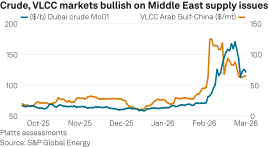
Heightened risks
Iran has seized control of Hormuz since the beginning of March, following US and Israeli strikes, only granting access to a small number of Asia-bound ships and its own tankers.
S&P Global Commodities at Sea data shows only 12 ships passed through the strait on March 28-29. Daily average transits reached 135 ships in February.
A growing number of Asian countries, like China, India, Thailand, Pakistan and Malaysia, have embarked on diplomatic efforts to secure energy supplies, and O'Neil said ships linked to the countries will have "the highest possibility of a safe route."
Also, vessels associated with European countries and Gulf States will face mid-level risks as Iran has yet to set out its stance towards those nations clearly, according to O'Neil. Ships with US and Israeli interests will have to endure the highest risks, he added.
US officials said the US Navy will start escorting tankers through Hormuz when military operations move into the next phase, while a multinational task force for a similar purpose is also under discussion.
Naval forces could come into the area in a week or two if "you start to see a settling of the situation," O'Neil said. "At the moment, no naval forces [are] coming into the area because the risks are too high."
Iran has been routing ships north of Larak Island into its territorial waters during their Hormuz passage. Alaeddin Boroujerdi, a member of the Iranian parliament's national security and foreign policy committee, said on state television March 22 that Iran was charging some ships a $2 million toll for using Hormuz.
But O'Neil questioned if a toll system could actually materialize on a semi-permanent basis. "I doubt the Americans would even allow it ... there may be some form of sanctioning for payments of those entities to pay the toll that are facilitating the Iranian war efforts."
Not like COVID
Columbia is one of the world's largest ship-management firms, providing crewing and technical services to 585 vessels. Currently, 10-20 of its ships manned by roughly 400 seafarers are in Persian Gulf waters, according to O'Neil.
The crew members have needed to enhance visual checks due to the widespread jamming of global navigation satellite systems in the region, but for the most part, their operational conditions remain safe, he said
"They are in anchorages which are perceived as safe. They are able to be rotated, and crew exchanges are and will take place," O'Neil said.
Unlike during the COVID pandemic earlier this decade, air traffic has continued in the Middle East, as well as essential goods and medical supplies, despite delays.
"It's very much a holding pattern, but it's still operating," O'Neil said. "This is not a COVID situation where you can't rotate crew, where there are restrictions on supply and maintaining of the vessels."
