Refined Products, Gasoline, Jet Fuel, Diesel-Gasoil
March 09, 2026
WAF products markets surge as stakeholders mull fallout from Middle East conflict
By Daniel Pelosi and Aruni Sunil
HIGHLIGHTS
STS Lome flat pricing bullish, tracking European gains
Highest gasoline, diesel prices since Platts launched assessments
Monitoring European, cross-African dynamics as conflict continues
West African refined product markets have seen a surge in prices across early-March, tracking bullish pricing trends throughout global markets amid conflict in the Middle East and the subsequent closure of the Strait of Hormuz.
Sentiment across jet fuel, diesel and gasoline markets in the region remains uncertain amid the tense geopolitical backdrop, with STS Lome prices across each respective market rising by 75%, 53% and 24% since the end of February.
This has driven diesel and gasoline values in the region to their highest values since Platts, part of S&P Global Energy, began assessments of the markets in April 2025, while STS Lome jet fuel pricing stands at its highest level since June 2022.
With ICE Brent crude futures exceeding $100/b across the weekend and into March 9, market concern surrounding further volatility and bullishness has persisted into the new week.
Spot values track aggressive global rallies
Values in the region's middle distillate complex have seen the most bullish reaction to the conflict, with prices tracking aggressive rises in European values as core Asian supply becomes increasingly unavailable amid the shipping disruption in the Persian Gulf.
In jet fuel, Platts last assessed STS Lome at $1,473.50/mt on March 6, climbing by $470/mt from the start of the week, while STS Lome diesel prices saw a $282.5/mt rise to $1,171/mt across the same period.
European jet fuel pricing has seen even stronger gains across March, rising by $645.25/mt from the start of the month to $1,476.50/mt CIF NWE as of March 6, while the March ICE low sulfur gasoil contract rose by almost 35% to $1,156/mt across the same period.
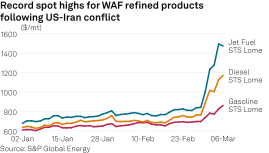
Upwards pricing pressure within the West African light ends market has been comparatively less pronounced, with regional supply of products like gasoline less immediately affected by disruptions to supply from the East. Despite this, the market has similarly reacted to bullish pressure within the European gasoline space.
Platts last assessed STS Lome gasoline values at $826.75/mt, up $34.25/mt day over day, and $123.5/mt from the start of the week as premiums to Eurobob swap values slowly rose from $10/mt to $16/mt across the same period.
Opportunities for WAF to plug supply gaps
While uncertainty has dominated domestic market stakeholders' initial reaction to the volatility, speculation surrounding European and broader African material supply if the conflict continues has prompted sources to signal opportunities for West Africa, particularly in middle distillates.
In the European distillates market, jet fuel is expected to tighten significantly in April as it pulls the bulk of its imports from the Middle East and India, with market players saying that the loss of supply will be a "huge problem."
"Jet is the interesting one: if Europe stays tight, we expect WAF premiums to go up in April as it signals the start of flying season," said a trader. "If the Strait stays closed, WAF is where those missing flows will come from instead."
On the diesel side, market participants have begun to price in a potential supply disruption and reflect higher freight costs. This comes even as the European diesel market is largely balanced in terms of supply despite higher prices being seen down the forward curve.
In terms of the impact of Africa, the trade disruption is likely to be more concentrated in the north and south of the continent, with both regions relying heavily on Middle Eastern materials in their operations.
Consequently, sources anticipate a potential capitalization on sustained strength in crack spreads from Nigeria's Dangote refinery, despite a closed arbitrage from the region into Europe, on paper.
"Cargoes will go from West Africa to South Africa and Europe," a distillates trader said. "All disruption now, everything is driven by the Middle East war, and WAF is benefiting positively from it."
This view is supported by current storage levels in the Offshore Lome complex, which have the potential to act as a supply buffer for the European market as the supply disruption continues. S&P Global Commodities at Sea data showed that as of March 2 there was 4.2 million barrels of diesel/gasoil in floating storage in the area, with recent large arrivals set to be fully discharged in the coming days.
Nonetheless, West African sellers remain cautious, with freight costs also resurgent and redelivery insurance expected to increase, coupled with a trickier legislative landscape following the latest EU sanctions package on products derived from Russian crude.
Tight supply of locally produced light sweet crude has raised questions regarding the ability of West African refineries to raise production rates to meet the anticipated rise in European demand for material.
"There is more restriction around what barrels can come into Nigeria now as Europe has tighter sanctions around Russian-origin refined products," a local trader said. "Can't say how this might pan out until we see more flows going from WAF to Europe -- it's not quite there yet, we will know soon."
A second trader expressed similar sentiment, noting it is "possible that Europe or South Africa may pull more, but there is still not enough crude for refineries to produce more fuel."

Editor: