Crude Oil, Refined Products, Maritime & Shipping, Fuel Oil, Jet Fuel
March 04, 2026
FACTBOX: Hormuz oil flows still at a standstill despite US insurance pledge
HIGHLIGHTS
Ship attacks drive crude prices up 20%
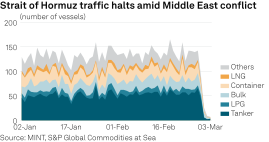
Hormuz traffic drops from 135 to 7 vessels
US has said will provide insurance, naval protection
Oil and shipping flows through the Strait of Hormuz remain stalled despite a US insurance pledge, as recent attacks and security threats keep vessel traffic at a near standstill.
"The situation remains fluid, but what's clear is that prolonged conflict is very bullish for cracks across the barrel in all hubs, and especially for European distillates," said Rebeka Foley, oil analyst at S&P Global CERA. She warned that if tensions persist, market volatility and elevated prices are likely to continue.
Trade flows
The Strait of Hormuz faces unprecedented disruption as military action threatens the world's most critical oil transit route.
- AIS signals show that seven vessels navigated the Strait of Hormuz on March 3 compared with nine on March 2, 26 on March 1, and 91 on Feb. 28. A daily average of 135 vessels crossed the Strait in February.
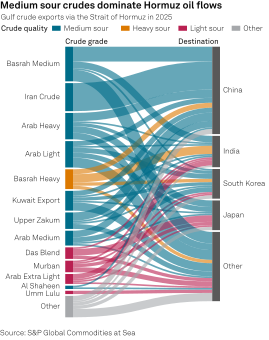
- Some 15 million barrels/day of crude and 5 million b/d of oil products passed through the Strait of Hormuz in 2025, according to data from S&P Global Commodities at Sea.
- One more vessel is set to load from Iraq's Basrah port at the mouth of the Strait of Hormuz before the OPEC producer is forced to shut off crude exports completely, two sources, including one senior official at Iraq's state oil marketer SOMO, told Platts, part of S&P Global Energy March 4.
- JPMorgan analysts warned oil producers may begin "shut-ins" if the chokepoint remains disrupted for 21 days.
- Vessels are beginning to reroute toward Yanbu on Saudi Arabia's west coast to support continued production. Just over 2.44 million b/d of crude have been loaded so far in March at Yanbu, compared with monthly averages between 650,000-1 million b/d over the preceding six months, according to CAS data.
- Crude exports from southern Iraq appear to have dried up after production cuts at the 1.2 million b/d Rumaila field.
- India's energy ministry said it has "ensured both availability and affordability of energy for its population by diversifying its sources," meaning it is not reliant on oil and gas through the Strait of Hormuz.
Prices
Energy prices across commodities continued to jump as fears of supply disruption grips the markets.
- Platts, part of S&P Global Energy, assessed Dated Brent at $84.87/b, up 9% on the day and up 20% from Feb. 27, before the strikes.
- Platts assessed Platts AGS, reflecting WTI Midland grade transported to the Gulf Coast from the Permian Basin, at $76.34/b March 3, up 5% on the day and up 12% from Feb. 27.
- Platts assessed the front-month Brent-Dubai EFS spread at Singapore MOC at $10.60/b March 4, up 74% day over day and up 769% from Feb. 27.
- The Platts VLCC index for non-scrubber-fitted, non-eco vessels soared 93% day over day March 3 to $519,104/b, which was 150% higher than Feb. 27.
- Platts assessed jet fuel barges on a FOB basis at Flushing-Amsterdam-Rotterdam-Antwerp-Ghent at $1,227.50/metric ton March 3, up 24% on the day and up 49% from Feb.27.
- Platts assessed ultra-low sulfur diesel barges on a FOB basis at Amsterdam-Rotterdam-Antwerp at $1,005.50/mt March 3, up 14% day over day and up 34% from Feb. 27.
- Bunker prices have risen across key hubs. Platts assessed delivered 0.5% sulfur fuel oil at Fujairah at $665/mt March 3, up 16% day over day and up 29% from Feb. 27. Its equivalent at Rotterdam rose 6% and 18% respectively, its equivalent at Singapore rose 9% and 21% respectively.
Infrastructure
Critical energy facilities across the Gulf have come under direct attack, disrupting operations and threatening supply chains.
- Oil storage and bunkering activity at the UAE's Fujairah port were disrupted March 3 after fires suspended operations. The Port of Fujairah was combating a "large fire" after being struck by falling debris from an intercepted drone.
- Saudi Arabia's Ras Tanura oil refinery has been targeted by a second attempted drone attack, but it sustained no damage, the state-run Saudi Press Agency reported March 4, citing the defense and energy ministries.
- The US embassy in Saudi Arabia warned of an attack on Dhahran, where Saudi Aramco -- the world's largest oil company -- has its headquarters.
- Four vessels are set between March 4-5 to load crude from Iraq's Basrah port with no further loadings immediately scheduled amid ongoing disruptions to shipments through the Strait of Hormuz, according to a copy of the loading program seen by Platts and a source with knowledge of the matter.