Refined Products, Diesel-Gasoil, Gasoline, LPG
February 16, 2026
South Korea to extend auto fuel tax cut through April 30 to ease consumer burden
HIGHLIGHTS
Gasoline tax cut remains at 7%; diesel at 10%
Local refiners welcome tax relief extension
Gasoil crack averages $19.52/b in Q1 so far
South Korea will extend its temporary auto fuel tax cut for another two months through April 30, keeping current reduction rates unchanged, the Ministry of Economy and Finance said in a policy briefing statement Feb. 13.
Under the extension, the government will apply a 7% tax cut for gasoline and a 10% tax reduction for diesel and LPG butane, according to the ministry.
The current cuts have lowered pump prices by Won 57/liter (4 cents/l) for gasoline and Won 58/l for diesel, while retail butane prices have fallen by Won 20/l, the ministry said.
"The decision to extend oil taxes is aimed at easing the financial burden on consumers amid ongoing volatility in global oil prices," the MOEF said.
South Korea's diesel demand fell 5.8% year over year to 12.97 million barrels in December, marking a third consecutive monthly decline, according to the latest data from state-run Korea National Oil Corp. issued Jan. 29.
Gasoline demand, however, rose 3.4% year over year to 8.46 million barrels in December, while LPG demand used for transport and industry rose 20.9% year over year to 12.84 million barrels, extending gains for a fourth straight month, KNOC data showed.
Refiners welcome extension
Local refiners welcomed the extension, saying the tax relief could continue to support domestic demand for transport fuels and overall refining margins, officials and product marketing managers at three major refiners, including S-Oil, told Platts, part of S&P Global Energy, over Feb. 12-16.
Both domestic and international demand fundamentals are important for local refiners as South Korea is Asia's fourth biggest oil consumer and the region's top clean oil product supplier or net exporter, a middle distillate sales trader at SK Energy told Platts over a market discussion meeting on Feb. 16.
Asian refining margins and crack spreads are expected to remain robust, supported by steady demand, tepid Russian oil product trades and the closure of US refineries, a spokesperson at S-Oil told Platts on Feb. 13.
Although Asian crack spreads have come off from November-December 2025 highs, limited Chinese and Russian supplies, robust demand for South Korean jet fuel from the US West Coast and the recovery in Asia's high-tech manufacturing sector should support the overall middle distillate margins, a product marketing manager at a major South Korean refiner based in Ulsan told Platts on Feb. 16.
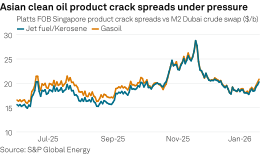
Platts assessed the second-month Singapore gasoil swap crack against Dubai crude swaps at an average of $19.52/b so far in the first quarter, down from $21.60/b in Q4 2025, but higher than the 2025 full-year average of $18.16/b.
Pump prices
Retail diesel prices, which climbed to Won 1,663/liter ($1.15/l) in the first week of December, fell to Won 1,582/l in the first week of February, tracking softer global crude prices, according to KNOC data.
Gasoline prices also declined over the same period, easing to Won 1,688/l in the first week of February from Won 1,746/l in the first week of December, KNOC data showed.
South Korea first introduced the temporary fuel tax cut in November 2021 to cushion households from surging energy prices and inflation, and has since extended the measure repeatedly.
