Natural Gas, LNG, Crude Oil
November 12, 2026
If price is right, industry sees no limit to US gas supply growth
Editor:
HIGHLIGHTS
Resource depth not an inhibitor: Vitol executive
Price softness driving some curtailments
The US enjoys a virtually endless supply of natural gas reserves and should have no meaningful upstream constraints to meet rising demand in the years ahead, according to several senior industry executives.
"I think gas supply in the US is as close to something that is infinite that you can possibly imagine ... at a certain price -- at a forward strip of, let's just say, $3-$3.50 [per MMBtu]," Ben Marshall, CEO of commodities trader Vitol Americas Corp., said during an energy conference hosted Nov. 10 at the Federal Reserve Bank of Dallas' Houston branch.
The industry will likely continue to see regional disruptions and price dislocations as demand grows, but the resource itself will not be an inhibitor, Marshall said.
"You're going to get spikes during the cold and obviously winter storm events and all that, but in the aggregate across the year, we see no shortage of gas," he said. "So any kind of price increase of 50 cents or even more, you're going to put a lot more on the market."
Following price
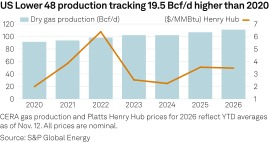
US Lower 48 gas production has outpaced total demand growth year to date and is averaging nearly 111 billion cubic feet/day, about 4.2 Bcf/d, or 4% higher than 2025's average, according to S&P Global Energy CERA data.
In 2025, production increased at a faster rate, rising 4.6% year over year to about 106.8 Bcf/d. CERA projects Lower 48 gas demand to grow by more than 32 Bcf/d between 2025 and 2031.
James Walter, co-CEO of Permian Resources Corp., said LNG and data centers are generating incremental demand for gas to which producers will continue responding in years ahead.
"If there's not enough gas, that will drive the prices up, and then you go from $3 to $4, and there's a whole new tranche of that gas available to drill economically in the US," Walter said Nov. 10 on an executive panel alongside Vitol's Marshall. "I think at whatever the price is, which would be driven by the amount of demand from those two sources and others, I think we will be able to rise to the challenge and meet that."
Over the last five months, cash prices at Henry Hub have averaged around $2.90/MMBtu, and the 2027 forward strip has declined from around $3.50/MMBtu in mid-June to less than $3/MMBtu more recently, according to data from Platts, part of S&P Global Energy.
As prices hit their trough in the seasonally less demand-intensive shoulder season, a number of producers have deferred bringing wells online, redirected 2027 development plans to cover more liquids-rich areas and curtailed production outright.
Current prices remain below the floor required to drive production growth even on the highest quality acreage in Appalachia and the Haynesville, CERA upstream analysts wrote in a fourth-quarter gas supply outlook published Nov. 10.
Expand Energy Corp. has identified $3.50-$4/MMBtu as the price range needed to incentivize incremental production growth from the Haynesville between now and 2030. "And then from 2030 to 2035, to stimulate that additional gas supply, we need to be about $4-$4.50," Expand CFO Marcel Teunissen said in September.
CERA upstream analysts expect decline in oil prices in the latter part of the decade to limit the rate of growth in associated gas which, when compounded with demand growth, is expected to drive Henry Hub prices higher and invite more incremental production from the gas basins.
"The Marcellus operators will respond first, mostly because of capacity for additional activity," the analysts wrote. "However, the Haynesville will see significant rig additions beginning in 2028, as oil prices (and thus, associated gas volumes) decline."
