Natural Gas, LNG
November 09, 2026
US midstream firms step up gas pipe plans ahead of expected demand surge
By Killian Staines and Susan Dlin
Editor:
HIGHLIGHTS
46.5 Bcf/d of proposed pipelines announced in 2026
More Permian projects advance after Solitude FID
Momentum builds for data center laterals
Midstream companies have stepped up natural gas pipeline projects in 2026 to connect production to an expected surge in demand from LNG terminals, power generators and data centers.
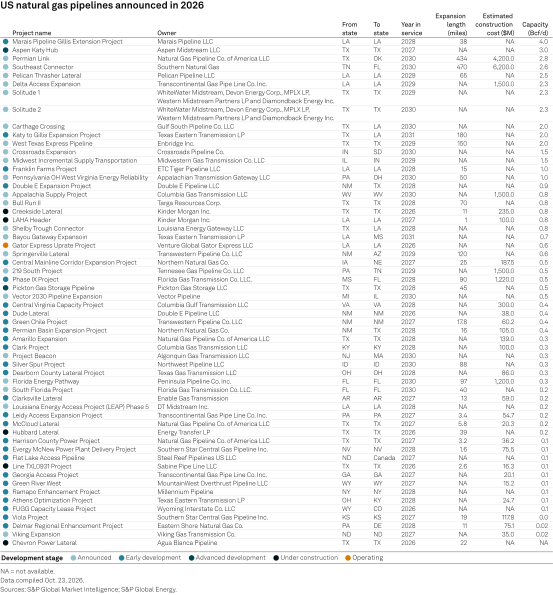
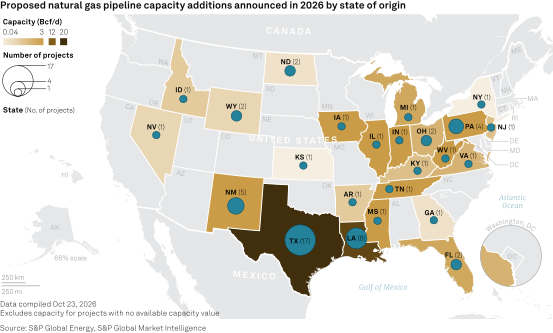
Platts, part of S&P Global Energy, has tracked 46.5 billion cubic feet/day of proposed pipeline projects announced so far in 2026. About 20 Bcf/d of this year's projects originate in Texas.
Announcements have ranged from long-haul Permian Basin egress pipelines to links between Texas and Louisiana's Gillis hub and laterals to individual data center campuses.
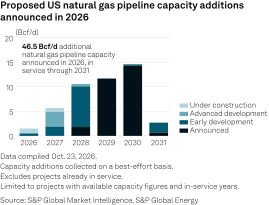
The largest of the Permian projects was the Solitude System, two pipelines from the Permian to the Katy Hub near Houston with a combined capacity of 4.5 Bcf/d, due in service over 2029-30. A WhiteWater Midstream LLC-led consortium reached a final investment decision on Solitude in August.
The FID suggested strong confidence in Permian production growth, considering that two greenfield egress pipelines started flowing gas in 2026, and two others that reached FID in 2025 are due to enter service in 2028-29.
"The Permian is the basin that keeps giving from a volume standpoint, and it's always paid to take the over in terms of gas pipeline productivity and volume outlooks," Mizuho Securities USA analyst Gabriel Moreen said in an interview with Platts.
Even after the Solitude FID, midstream companies have advanced more Permian projects. Kinder Morgan Inc. said Oct. 21 it had reached FID on Permian Link, a 2.8 Bcf/d expansion of its NGPL to move gas into the Texas Panhandle region, following an open season in May. And Enbridge Inc. announced Sept. 15 an open season for its West Texas Express Pipeline Project, which would add 2 Bcf/d from the Permian to El Paso, Texas, and could include supply laterals to Mexico.
"I am a little bit surprised that we continue to see additional open seasons announced for projects ... after you had an FID of Solitude," Moreen said. "That having been said, I think there's a lot of nuances in terms of where Permian gas wants to go."
Permian Link will serve growing power generation demand, Kinder Morgan CFO David Michels said Sept. 30 at an industry event. "This one is uniquely positioned, I think, because it's a demand-pull project; it's not supply push," Michels said. "So we think it's relatively insulated from an impact from Solitude."
LNG demand
Midstream companies have been developing projects to link Permian and Haynesville production with rising Gulf Coast demand, particularly from LNG.
Aspen Midstream LLC reached FID in May on a 3 Bcf/d header system in Katy, with a goal to blend Permian gas with lower-nitrogen supplies from the Austin Chalk for delivery to nitrogen-sensitive LNG terminals. "There's a wave of new pipelines coming from the Permian and other supply basins, and there's a big wave of pipelines going to the Southeast for LNG, power, industrial type markets," co-CEO Matt Ray told Platts at the time.
Enbridge announced Oct. 1 an open season for a 2 Bcf/d Katy-to-Gillis expansion, which it described as "the missing puzzle piece connecting gas molecules arriving at Katy with key demand markets in Gillis, Louisiana."
Gillis continues to grow as a supply hub for rising demand in Louisiana. Venture Global Inc. is seeking state approval for the 4 Bcf/d Gillis Extension Project, connecting the hub to the Marais Pipeline that will supply the CP2 LNG terminal.
The Williams Cos. Inc. reached FID on the 2.25 Bcf/d Delta Access Pipeline which will run from Gillis and supply LNG and power demand. It also sanctioned the 750 million cubic feet/day Shelby Trough Connector linking the Shelby Trough on the Texas side of the Haynesville to existing Williams pipelines that run to Gillis. "The Haynesville is going to be the primary supply point for that area," Williams CEO Chad Zamarin said during its second-quarter earnings call.
Data center demand
Data center demand has started to show up in earnest in pipeline projects this year, with companies announcing a slate of laterals to directly serve campuses.
"From the pipeline and even gas utility companies that we're talking to, discussions are more active than ever," Moreen said.
Texas has seen its fair share of projects, including NGPL's Amarillo expansion to supply an Alphabet Inc. data center in the Panhandle, and Energy Transfer LP's Hubbard project to supply 150 MMcf/d to Nexus Data Centers LLC's Hubbard Campus.
Outside of Texas, Energy Transfer is developing the 400 MMcf/d Green Chile Project in New Mexico to serve Oracle Corp.'s Project Jupiter data center campus, and the 1 Bcf/d Franklin Farms project, supplying gas to new stations that will power Meta Platforms Inc.'s Hyperion data center project. It is also planning the Clarksville Lateral for a data center in Arkansas.
Lateral projects are attractive to pipeline companies because they have high returns and relatively low capital commitments, Moreen said. "In some cases, our understanding is the hyperscalers themselves even cover the capital commitment or the capital cost of the lateral project."