Natural Gas, LNG
May 18, 2026
Golden Pass LNG feedgas deliveries fall amid planned maintenance
By Corey Paul and Santiago Canel Soria
Editor:
HIGHLIGHTS
Seasonal turnarounds weigh on US LNG utilization in May
Work underway at Cameron, Freeport plants
Feedgas deliveries to the Golden Pass export terminal were near zero for a sixth consecutive day on May 18, which the operator of the Texas facility attributed to planned maintenance after shipping the second cargo from the facility.
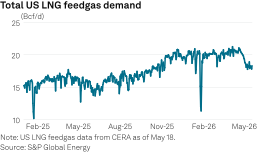
The outage at Golden Pass added to seasonal maintenance work underway at export terminals along the US Gulf Coast, reducing overall US utilization in May as the war in the Middle East continues to support strong demand for US supply.
The operators of the Freeport LNG terminal in Texas and the Cameron LNG terminal in Louisiana have also confirmed planned maintenance.
The nine major LNG terminals operating in the Lower 48 were scheduled to receive about 18.3 Bcf/d of feedgas on May 18, S&P Global Energy CERA data showed, based on nominations for the morning cycle that could later be revised. The daily flows were in line with average deliveries in May, which were down from an average of about 20.5 Bcf/d in April.
Golden Pass did not provide the reason for the planned maintenance work or an estimate for how long it would last.
"Golden Pass confirms a planned outage at our LNG terminal to address normal start up related maintenance as we continue to ramp Train 1 to full capacity," a spokesperson said.
Days before the outage, feedgas deliveries to Golden Pass reached higher than 400 million cubic feet/day, which is below full utilization levels for Train 1, CERA data showed. The terminal exported its second cargo on May 9.
Spring maintenance at US LNG facilities is typically clustered around May and June.
Cheniere earlier confirmed completing planned maintenance at its Corpus Christi terminal in Texas, which appeared to begin at the start of the month and end about a week ago, based on feedgas flows.
Freeport on May 13 confirmed taking one of the plant's three liquefaction trains offline for scheduled maintenance that it expected to last "several weeks."
Cameron confirmed the start of maintenance May 1. Similar turnarounds at the facility in recent years lasted around three or four weeks.
Maintenance across US LNG facilities is helping to keep prices elevated by tightening spot supply amid steady demand for US volumes, although the work is also easing pressure on Atlantic freight rates by increasing vessel availability, according to market sources.
In a bid to secure prompt cargoes, India's GAIL issued a swap tender offering an FOB cargo loading from Sabine Pass, Louisiana, for July 21 and another from Cove Point, Georgia for July 15 in exchange for two cargoes delivered to Dahej, India, on June 1–12 and July 1–10. The tender closes May 19.
The war in the Middle East is continuing to constrain about 20% of global LNG supply that typically transits through the Strait of Hormuz.
Platts, part of S&P Global Energy, assessed the FOB Gulf Coast Marker for cargoes loading 30–60 days forward at $15.50/MMBtu on May 18, up 4 cents day over day, tracking gains in destination markets while remaining about 68% above pre‑war levels and at the highest since April 7.
In the Pacific, Platts assessed the July JKM benchmark price reflecting LNG delivered to Northeast Asia at $19.689/million British thermal units on May 18, an increase of about 7% from the previous assessment and about 84% higher than prewar levels.
In the Atlantic, Platts assessed the DES Northwest Europe marker for July at $16.83/MMBtu on May 18, an increase of about 1% day over day and still about 70% higher than before the conflict.
Across LNG shipping, Atlantic two-stroke rates were assessed at $94,000/day May 18, down from a peak of $300,000/day reached on March 5 at the height of the Middle East conflict. In the Pacific, two-stroke rates were assessed at $65,500/day, unchanged day over day but still below the $210,000/day peak seen on March 6.
