Energy Transition, Coal, Electric Power, LNG, Natural Gas, Carbon, Emissions
March 31, 2026
FEATURE: Low gas storage, LNG disruption to test European resilience in Q2
Editor:
HIGHLIGHTS
Qatari LNG outage key uncertainty for storage fill
Power price evolution to vary according to market
Carbon allowances in period of high volatility
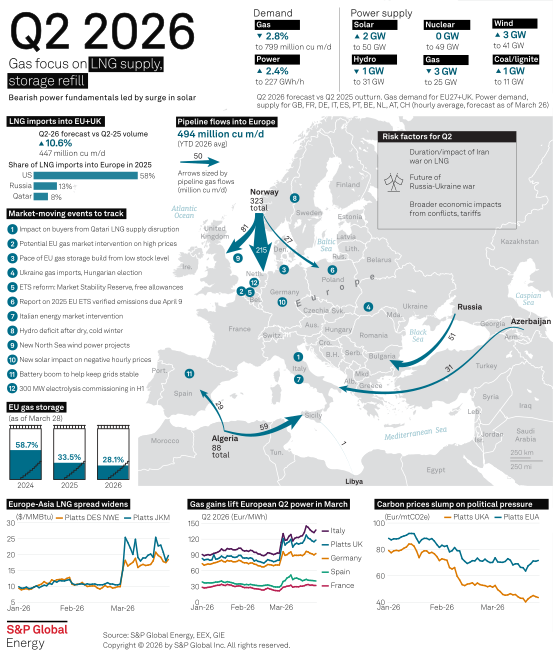
As the Middle East war bleeds into a second month, unprecedented disruptions to global LNG supply, low gas storage levels, and geopolitical uncertainty have primed the European gas market for a potentially tumultuous second quarter.
The conflict continues to choke transit through the Strait of Hormuz, cutting off roughly 20% of the world's LNG supply from international buyers. Even if fighting were to subside, the war has already dealt a significant blow to gas markets, with Iranian attacks curtailing some 17% of Qatar's LNG export capacity for three to five years.
QatarEnergy's other LNG production also remains offline after it halted output in early March.
The EU itself has limited direct exposure to Qatari LNG. In 2025, Qatar accounted for about 8.2% of its total LNG imports, according to data from S&P Global Energy CERA. And EU leaders have repeatedly maintained in recent weeks that the continent's gas supply is secure.
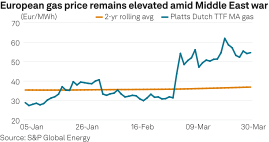
However, Europe's deepening reliance on LNG for baseload gas needs since the 2022 outbreak of the Russia-Ukraine war means it remains exposed to price risks in the intensely global market amid heightened competition with LNG buyers in Asia, the main offtake market for Persian Gulf exports.
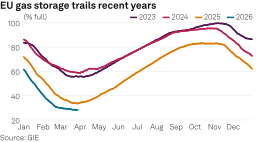
With cold weather waning, Europe's focus is shifting to rebuilding gas storage ahead of next winter. That will be an uphill effort. Stocks entering spring are at their lowest level since March 2022. EU-wide gas storage was 28.1% full as of March 28, according to data published by Gas Infrastructure Europe. At the same time in 2025 and 2024, it was 33.5% and 58.7% full, respectively.
The duration of the full-scale Qatari outage remains a key uncertainty. CERA analysts expect European gas storage could reach roughly 78% full by the end of October if Qatari production is offline for three months and takes eight weeks to ramp up. While lower than recent years, it would still surpass a theoretical minimum fill level allowed under flexibilities in the EU's latest storage regulation.
But if the outage stretches to five months, the CERA analysts project EU storage would only hit 67% full by next winter, leaving the continent a diminished buffer against price spikes heading into next winter.
"Any extension of disrupted Qatari/UAE gas flows beyond the [three-month] base case would significantly tighten Europe's end-summer storage outlook," said Dominic Simmons, senior principal gas analyst for CERA.
Demand-side responses to the recent market turmoil could offer a tailwind to the storage fill, with elevated gas prices expected to temper European consumption, according to CERA analysts.
They project industrial gas demand across the EU and UK -- previously forecast to rise -- will now fall by 0.8% year over year in 2026.
Power variations
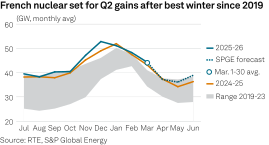
The outlook for power prices in the second quarter varies significantly across Europe, with more gas price-linked markets like Italy and the UK most affected, while French and Iberian power prices remain decoupled from other markets due to oversupply from solar and nuclear.
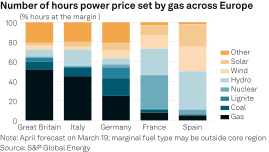
Solar is forecast to exceed nuclear at the top of the Q2 power mix across the 10 core nations in the CERA forecast, with solar capacity now above 400 GW across the EU27.
Germany alone has almost 120 GW of solar capacity installed, but output could be lower year over year, with curtailments and zero prices still an issue despite higher prices outside solar peak hours.
CERA analysts forecast a nearly 20% year-over-year increase in the number of low-priced hours (below Eur10/MWh) in the second quarter.
"This adds pressure on prices during solar peaks," said Kerry Thacker-Smith, senior power analyst at CERA. "However, higher gas prices provide support to early morning and evening prices, resulting in higher intraday spreads."
This dynamic could further boost battery economics, but Europe's current installed 60 GW of home and utility-scale battery capacity is not yet sufficient to significantly narrow intraday spreads during spring.
German lignite is set to see the biggest year-over-year gains in the second quarter, while Italian gas-fired generation could see the biggest year-over-year decline across markets covered by CERA forecasts.
Overall, CERA analysts forecast a 14% decline for gas-fired generation across core markets compared with Q2 2025, with only limited gas-to-coal/lignite switching potential during the spring.
However, some of the gas-switching could be across borders, with lower carbon prices benefiting coal burn in Eastern Europe.
The biggest forecast swing is on external borders, with core markets set to swing from 2 GW net exports in Q2 2025 to 2 GW net imports.
"Poland and Czechia are the main beneficiaries of the current fuel switching dynamics, with Germany set to swing to net imports," said Dan Muir, German power analyst at CERA. "A lot of this is then being re-exported either towards the British or Italian markets."
Hydro remains a key variable to European power prices this spring, particularly in light of the exceptional wet conditions in Q2 2025.
While a hydro deficit looms in the Nordics, Iberia faces a third consecutive oversupplied spring after a wet winter.
The expected demand recovery could face headwinds if prices remain high for longer, with CERA currently forecasting a 2.4% year-over-year increase across core markets.
Carbon volatility
The EU carbon market, meanwhile, endured one of its most volatile periods in over two decades during the first quarter of 2026, as prices swung sharply in response to mounting policy uncertainties and reform pressures.
With the Middle East conflict still unresolved and gas prices on the up, increased gas-to-coal switching among power generators is expected to provide underlying support for EU Allowances in the coming months.
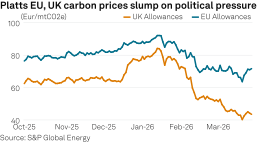
EUAs surged to 30-month highs of Eur92.09/metric tons of CO2 equivalent on Jan. 15, according to Platts data, before plunging by almost Eur30/mtCO2e to reach lows around Eur62/mtCO2e by mid-March.
The dramatic reversal came as leaders from Italy, Germany, France, Czechia and Slovakia intensified calls for an overhaul of the bloc's emissions trading system, arguing that the current rules were undermining industrial competitiveness.
The political pressure prompted the European Commission to announce reforms to the Market Stability Reserve -- a move signaling additional allowance supply entering the market in the near term.
The MSR, a mechanism designed to address supply-demand imbalances in the EU ETS, has held surplus allowances since its launch in January 2019. Changes to its operation could fundamentally alter the market's supply dynamics going forward.
However, countervailing support emerged in late March, with the EC unveiling measures to strengthen price-stability mechanisms alongside a Eur30 billion investment fund backed by allowance sales. These initiatives helped lift prices back above Eur70/mtCO2e by the end of the first quarter, though market participants remain measured about the outlook amid ongoing policy debates.
"Despite the gains, sentiment remains cautious, with EUAs largely macro-driven and sensitive to geopolitical shocks," CERA analysts said in a recent note. "Markets are now focused on forthcoming EU ETS reforms, which are expected to determine the next directional move."
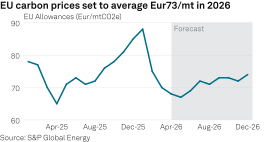
The coming months are likely to see continued price volatility, according to analysts and traders, as the market digests the implications of MSR reforms and awaits clarity on the investment fund's implementation timeline.
The European Commission has till the end of July to present a formal ETS review to help curb the volatility of the carbon price and mitigate its impact on electricity prices.