Fertilizers, Chemicals, Energy Transition, LNG, Renewables, Emissions
March 26, 2026
INTERVIEW: Elengy sustains European LNG offerings, advances transition aims
By Matt Hoisch and James Burgess
Editor:
HIGHLIGHTS
French operator expects near term 60% average LNG utilization
Plans to convert Fos Tonkin terminal for CCS by 2030
Eyeing ammonia imports, cracking for local hydrogen industry
French LNG terminal operator Elengy anticipates its existing import infrastructure will remain key for France over the coming years, even as the company positions itself for greater involvement in a low-carbon energy system, the company's chief strategy, sales and business development officer told Platts, part of S&P Global Energy, in a recent interview.
"We do not see a need for more [LNG] capacity in France," Christophe Thil said. "But we think that our current capacity will be useful for the energy system."
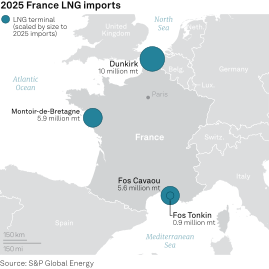
France was Europe's largest LNG importer in 2025. It brought in some 22.5 million metric tons of the super chilled fuel across the year, according to data from S&P Global Energy CERA.
Elengy operates three of the country's four LNG terminals: Fos Tonkin, Fos Cavaou and Montoir-de-Bretagne. Belgian gas infrastructure firm Fluxys runs the fourth terminal in Dunkirk.
Elengy expects its LNG facilities will continue to see robust use into the next decade, Thil said.
"We should have an average import utilization rate around 60%," he said. "Our view is that LNG will be key in the security of gas supply in the coming years and that we have to be as efficient as possible."
Maintaining LNG operations does not preclude preparing to handle alternative energy sources, however.
In the near term, Elengy has developed eight bioLNG bays across its three terminals: four at Fos Cavaou and two each at Fos Tonkin and Montoir, according to Thil. However, the service has so far seen low demand absent regulatory incentives, he added.
"It's a bit disappointing for us," Thil said. "The market is still in a wait-and-see position but that could accelerate quickly when regulation is in place."
Energy transition ambitions
Further shifts are set from 2028, when Elengy will move the Fos Tonkin site away from LNG to energy transition efforts.
The company does not anticipate the changes will strain France's energy security, as Fos Cavaou is expected to be able to handle added LNG cargoes from the Tonkin transition.
"We don't see any risk for the French gas supply," Thil said.
Elengy plans to convert the Fos Tonkin terminal into a low-carbon ammonia import and CO2 export facility, where it will receive and liquefy CO2 from industrial emitters before shipment for permanent geological storage.
The Rhone CO2 project could reduce CO2 emissions by 4 million mt/year by 2030, Elengy said on its website. Meanwhile, the ammonia import terminal aims to supply regional industries as well as cracking the ammonia back into hydrogen to supply local refineries, Thil said.
Elengy is working on the ammonia project in partnership with trading company Trammo, he said.
Elengy has completed pre-front-end engineering design work, and is in discussions for FEED studies, targeting a final investment decision in 2027-2028, Thil said. The facilities could be commissioned in 2030-2031.
European carbon prices are key to develop the low-carbon projects, Thil said.
"The fact that there is some hesitation in the European regulation on ETS could impact some CCS projects," he said.
He welcomed the EU's Carbon Border Adjustment Mechanism as a tool to level the playing field with higher carbon-intensity imports, saying the tax could help the company to take FID on low-carbon projects.
Elengy is also planning a CO2 export terminal at its Montoir terminal, the GOCO2 project, which has carried out feasibility studies and emitter cement companies have received French government backing as part of the project.
Heidelberg Materials, Lafarge and Lhoist have committed to working with Elengy on the project, and a further 10 companies have registered expressions of interest, Elengy said on its website.
Elengy estimates GOCO2 could ship 2.2 million mt/year of CO2 by 2031.
Thil said that CCS was ready to deploy technically, but alignment on specifications and coordination along the value chain could present barriers.
"I think the technical issues are not that difficult," he said. "Every piece of the puzzle exists. The capture exists, the geological storage of CO2 is something that exists. But the coordination and the alignment of all the counterparties all along the value chain on spec, on the quality of the CO2, for instance, or the pressure of the cargoes or the type of transportation need to be made before the launch of FEED studies."
Middle East war uncertainty
Thil was cautious about the potential impact from the US-Israel war with Iran on energy transition projects, noting European industries' vulnerability to high natural gas prices.
European LNG prices have skyrocketed amid the war.
Platts assessed the DES Northwest Europe marker at $17.466/million British thermal units on March 25, down 1.8% day over day. While it has sunk from recent peaks, the benchmark remains some 77% higher than before the conflict began in late February.
"If the situation lasts, it could have a negative impact on industry in Europe," Thil said. "But it could also create a move to accelerate this energy transition."
However, he warned that the drive to protectionism could damage ammonia import prospects, should national governments seek to remove dependency on energy and commodity imports.
