May 18, 2026
US says China agreed to address rare earth supply concerns

By Euan Sadden
Editor:
HIGHLIGHTS
Rare earth deal not mentioned in follow-up statements from Beijing
No reference to new export controls due to take effect Nov 2026
China has agreed to address US concerns over shortages of rare earth elements and other critical minerals caused by Beijing's export restrictions, according to a White House factsheet released May 17.
The factsheet outlines the agreements reached during the two-day summit in Beijing on May 14-15 between US President Donald Trump and Chinese President Xi Jinping. As part of the deal, Beijing also pledged to address US concerns about China's restrictions on rare-earth processing equipment and technology.
"China will address US concerns regarding supply chain shortages related to rare earths and other critical minerals, including yttrium, scandium, neodymium, and indium," the statement said.
The White House further noted that China would address US concerns regarding prohibitions or restrictions on the sale of rare earth production and processing equipment and technologies.
Rare earths were not mentioned in China's Ministry of Commerce's own summary of the US-China summit, released on May 16.
China's export controls on several heavy rare-earth elements—including dysprosium, gadolinium, lutetium, scandium, terbium, and yttrium—as well as on associated metals and magnets, took effect on April 4, 2025, following US Liberation Day tariffs. These measures triggered a sharp decline in exports of rare earths and permanent magnets, prompting several automotive production lines across the US and Europe to shut down.
Although export volumes recovered in June and July 2025 as trade tensions eased, Western industry groups, such as the European Association of Automotive Suppliers, continued to report inconsistent and unpredictable export licensing approvals throughout the second half of 2025.
A second wave of export controls, covering five additional rare earth elements—samarium, gadolinium, lutetium, europium, and ytterbium—along with related products, equipment, and technologies, was initially slated for Nov. 7, 2025, but is now scheduled to take effect on Nov. 10, 2026.
In an emailed statement to Platts, part of S&P Global Energy, Henry Sanderson, associate fellow at the Royal United Services Institute, described the White House's list of rare earths as "curious."
"Yttrium I can understand, as that is mostly what the US imports from China, but neodymium was never on the initial controls last April, and I don't believe there is a shortage of that outside of China," Sanderson said.
Sanderson added that the wording of the factsheet suggests China will retain its export licensing system. "Most importantly, there is [no statement] on the one-year pause of last November's controls," he noted.
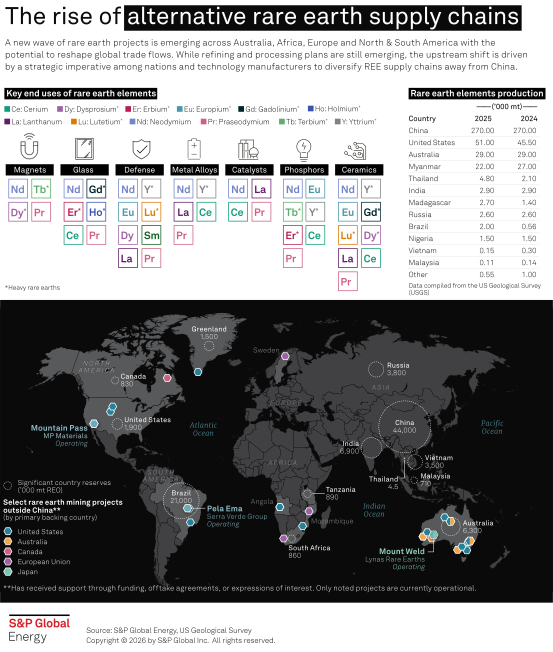
The US and other developed economies are heavily reliant on China for rare earth elements and their associated products. According to the International Energy Agency, China accounted for 61% of the global mined supply and 91% of global refining and processing capacity for key rare earths in 2024.
China also maintains a dominant position in processing other critical minerals, including lithium, copper, cobalt, and graphite.
Platts assessed neodymium-praseodymium oxide at $120/kilogram CIF North America on April 30, down $5/kg from the previous month.