Metals & Mining, Non-Ferrous
April 09, 2026
Queensland miners push for rail upgrade amid copper smelter closure risk

Editor:
HIGHLIGHTS
Miners push for 1,000-km rail upgrade
Flooding disrupts critical minerals transport
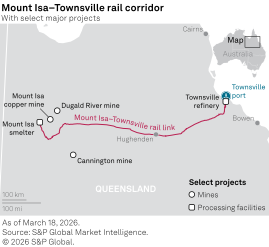
Miners are requesting upgrades to a 1,000-kilometer major rail corridor to support the next wave of Queensland's critical minerals, ahead of the potential closure of Glencore PLC's copper smelter and refinery in the Australian state.
The North West Minerals Province in Far North Queensland holds about 75% of the state's base metal mineral endowment, including copper, lead, vanadium and zinc, as well as major silver and phosphate deposits and rare earth potential, according to the state government.
In the area are Glencore's Mt Isa copper smelter and Townsville copper refinery. The company secured A$600 million in October 2025 from the state and federal governments to keep the assets operational until the end of 2028. The operations are under pressure from a "fierce" copper smelting market that is "not a level playing field," Glencore Metals Australia Interim CEO Troy Wilson said.
Since Glencore's underground copper mines at Mt Isa closed in July 2025, the copper smelter has been entirely reliant on third-party concentrates, predominantly from mines across north-west Queensland.
The copper smelter's closure would leave miners with no onshore value-adding option in Queensland. They would have to ship concentrate by rail to Townsville's port for export, but the track requires major upgrades to ensure exports can reach the market and equipment can be brought in, as it is vulnerable to flooding.
The rail line is also essential for other critical minerals mines in the region at the development and exploration stages, Maria James, CEO of economic development advocacy body Mount Isa to Townsville Economic Development Zone Inc., told Platts, part of S&P Global Energy.
However, in March, the industry was dismayed when the federal government's Infrastructure Australia agency removed an upgrade to the rail corridor from the mining, smelting and refining hub at Mt Isa to Townsville's port from its 10-year priorities list.
"The rail corridor upgrades taken off the priority list included enhancements to the western link of the line -- this is of critical importance to MITEZ and the NWMP. Although much of the line needs improvement, the priority is the western part on the black soil, which is more prone to long-term flooding," James said.
Resilience and continuity
Such weather impacts have historically hindered copper, zinc, lead and silver exports for weeks at a time, according to James, whose industry group includes major miners Glencore, South32 Ltd. and MMG Ltd. as members.
"The resilience and the continuity of that rail line under any conditions are imperative to the health of domestic and international contracts and take-or-pay agreements," James said.
As products from Glencore, MMG's Dugald River and South32's Cannington mines all travel on that rail line, together with all the mining inputs coming westward from the port, "there is no way [the rail line] can withstand 10 years of no funding," James said.
Another alternative for miners is to truck the concentrate to port, but this is dangerous as that route is used by tourists, Mt Isa Mayor Peta MacRae told Platts.
The A6 Flinders Highway is already configured for the triple road trains used when the rail line floods, but this comes at an additional cost to miners, who also face difficulty sourcing them, James said.
Glencore backs rail upgrade
A "transformation study" is underway as part of the government lifeline for Glencore's copper smelter and refinery, which includes considering ways to tie in the region's other critical minerals, according to MacRae. This makes the rail upgrade all the more important.
MacRae said the rail upgrade will likely be considered in the transformation study. About 40 industry and local government stakeholders named logistics as key during a meeting in March with federal and state ministers.
"My understanding is the transformation study is looking at the economic ecosystem of the whole [NWMP] to see what common user infrastructure could enhance getting all the minerals out of the ground," said MacRae, whose council is among stakeholders providing input to the study.
"Glencore believes that, if the government is serious about realizing the full economic potential of North Queensland, the rail corridor and freight route require material investment and that both should be reinstated on Infrastructure Australia's national priority list," a company spokesperson told Platts.
"Major disruptions, including weather impacts, result in economic losses for businesses across the region and can also impact supplies to domestic and international customers," the spokesperson said.
Glencore has planned A$2.5 billion in capital spending in the region over the next six years. This includes A$720 million for George Fisher, which has a mine life to at least 2042, to ramp up zinc, lead and silver production, the company said during a community information session in Mt Isa in early March.
The plan also includes the feasibility-stage A$1 billion Black Star open-cut zinc-lead-silver mine.
Infrastructure Australia did not immediately respond to requests for comment.
