Metals & Mining, Non-Ferrous
April 08, 2026
RARE EARTHS SERIES: State intervention needed to reshape rare earths market

Editor:
HIGHLIGHTS
Governments intervene to break China monopoly
State support levels playing field for producers
Public funding attracts private capital investment
Rare earth elements have come under increasing focus owing to their criticality to defense equipment manufacturing and clean technology. China has monopolized this supply chain for over two decades and has not shied away from using it for geopolitical leverage, forcing others to think of a diversification strategy. This is part 4 of a 5-part series in which Platts News explores the strategies under play and the challenges they face.
Government support is emerging as the most effective strategy for nations to cut their dependence on China's rare earths supply chains, as market forces alone could not overcome China's entrenched dominance in the sector, according to industry participants.
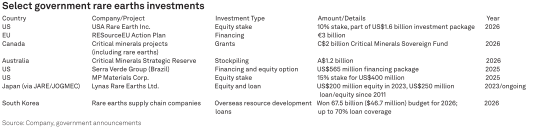
From equity investments and subsidies to streamlined permitting and price floors, the US, EU, Australia and other nations are providing unprecedented support to build an independent supply chain for rare earths, a group of 17 elements used in permanent magnets that are critical to defense and clean energy applications.
Despite concerns that state participation could disrupt market competition by favoring a few players, these government tools are crucial in establishing a supply chain outside China, whose near-monopoly of the sector has essentially driven competitors away.
"Support from Western governments is highly valuable because it levels the playing field with other countries that subsidize their industries," Kim Casey, director of investor relations at Energy Fuels Inc., told Platts, part of S&P Global Energy.
Energy Fuels is seeking US government support to advance the rare earths processing capacity of its White Mesa uranium mill in Utah, Casey said.
'Skin in the game'
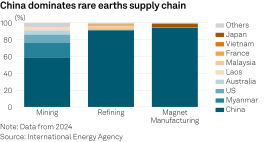
Chinese restrictions on its rare earths exports have increased the urgency for industry players to seek alternative sources of the material. China controlled 59% of rare earths mine production, 91% of refined production and 94% of magnet manufacturing in 2024, according to the International Energy Agency.
With China flooding the market with subsidized rare earths products, any new entrants are expected to struggle without government backing, as downstream consumers are unwilling to pay higher prices to support an alternative supply chain.
State support will help mitigate this risk for non-Chinese rare earths companies, according to industry players.
"Governments have a track record of addressing these gaps using legislative, financial and diplomatic tools to secure raw materials against a backdrop of geopolitical tensions and supply concentration," Hannah Levinger, a senior economist at Germany-based KfW Research, told Platts.
KfW Research is part of KfW Group, a German state-owned investment bank that serves as the central point of contact for Germany's raw materials fund. The fund provides financing for projects in exchange for minority stakes granted to the German federal government.
Government intervention also provides the foundations needed to develop a "functioning market" for rare earths that does not yet exist outside of China, according to Ian Donabie, manager of corporate communications at Australian Strategic Minerals Ltd. The company is developing the Dubbo rare earths project in New South Wales, Australia.
"Standing up what is effectively an entirely new industry -- one that competes at commercial scale -- requires policy alignment and government support to get off the ground," Donabie told Platts.
Risk-averse private investors are also likely to be attracted to rare earths projects that have public funding, said Gracelin Baskaran, director of the Critical Minerals Security Program at the Center for Strategic and International Studies, a think tank based in Washington, DC.
"Financing from governments is a very powerful catalyst for private capital," Baskaran said in a recent lecture in Manila, Philippines.
"It shows a commitment that the government often has skin in the game, which is really important. It often doesn't have to be a lot of money, but we do often see that to be quite powerful," Baskaran added.
Own merits
Government support is not about picking winners. Instead, it helps set rules to create conditions for sustainable supply chains, a spokesperson for the European Investment Bank told Platts. EIB is the lending arm of the EU, committing Eur1.2 billion ($1.4 billion) in financing for critical raw material projects in 2025.
"Ultimately, projects must still stand on their own merits: strong economics, solid [environmental, social and governance] performance, and strategic relevance," the EIB spokesperson said.
While state support boosts private investor confidence in rare earths projects, these developments must still demonstrate their ability to deliver a reliable supply, as shifts in policies or governments may result in the reallocation of funds.
"Rare earth companies must still be able to prove they can deliver, and those who can do so at a lower cost will be the ones that survive and thrive," Energy Fuels' Casey said.
Platts on March 31 launched four first-of-their-kind price assessments for rare earth elements, focusing on mine-to-industry alternative supply chains.
