Electric Power, Metals & Mining, Nuclear, Non-Ferrous
March 27, 2026
BHP eyes 1 mil mt/y of copper output in South Australia by late 2030s

Editor:
HIGHLIGHTS
Addition of Oak Dam discovery to boost production
Current South Australia copper output is 316,000 mt/y
BHP Group Ltd. could produce up to 1 million metric tons/year of copper by the late 2030s in South Australia with the addition of the Oak Dam discovery.
South Australia is key to BHP's growing copper production base, which now accounts for over half of its group earnings, according to the diversified miner's results for the half-year ended Dec. 31, 2025.
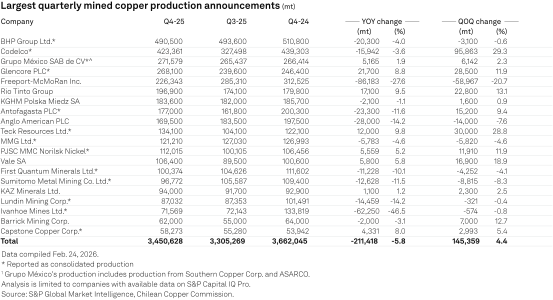
BHP, already the world's largest copper producer according to S&P Global Market Intelligence data, announced plans in 2024 to double its South Australian copper production capacity to over 650,000 mt/y by the mid-2030s.
This announcement followed the delineation of a "significant" maiden resource at Oak Dam, a deep iron oxide copper-gold system located 65 km southeast of BHP's Olympic Dam production hub. The planned expansion will be facilitated by BHP's 2023 acquisition of OZ Minerals Ltd., which includes the Prominent Hill and Carrapateena mines.
Geraldine Slattery, president of BHP's Australian operations, told the Minerals Week conference in Canberra March 24 that "we are on a pathway toward around 500,000 mt of annual production by the mid‑2030s, with potential to double that by the late 2030s."
William Mason, senior principal analyst for mine economics and emissions at S&P Global Energy CERA, said in a March 26 email, "The 1 million mt being referred to here is a hint at an upper estimation of the [copper] production with the inclusion of Oak Dam."
When asked to elaborate on how BHP would reach that higher number, a spokesperson for the miner directed Platts, part of S&P Global Energy, to CFO Vandita Pant's Feb. 17 results speech for the second half of 2025.
"With strong and reliable performance at Olympic Dam, and the addition of Carrapateena and Prominent Hill, Copper South Australia is well positioned for growth toward 650,000 mt/y of copper -- or close to 1 million mt including byproducts -- in the late 2030s, and to do so at a competitive capital intensity," Pant said.
BHP is expected to benefit from the projected increase in the London Metal Exchange three-month copper price, rising from an average of $12,137/mt in 2026 to $13,050/mt by 2035, according to CERA. However, "the ongoing war in the Middle East is expected to keep copper prices under pressure, with recovery unlikely until tensions ease," CERA analysts wrote in a March 25 note.
Foundation for growth
BHP's Copper South Australia operation currently produces around 316,000 mt/y of copper, which "equates to a little over 1% of the global copper cathode market," Slattery said in Canberra.
The South Australian business would be a global top-15 copper-producing asset, the fifth-largest gold producer on the Australian Securities Exchange, and produce around 5% of the world's uranium if it were a standalone business, Pant said in the half-year speech.
"This is a considerable base from which to grow," Pant said.
CERA's Mason said Copper South Australia's expansion to 500,000 mt of copper is planned for the first phase, followed by a second phase to 600,000 mt. These are centered around current mines -- Olympic Dam, Prominent Hill and Carrapateena, along with the smelter and refinery expansion.
Work at Olympic Dam involves shaft deepening, hoist upgrades, ore pass capacity increases, southern decline and processing improvements, Mason said.
With the sinking of the Wira shaft for Prominent Hill's expansion completed, work on its hoisting infrastructure should wrap up in fiscal 2027, according to Mason.
Carrapateena's development involves transitioning part of the mine from sub-level cave to block caving to increase ore mined from 4.5 million mt/y to 7 million mt/y, and eventually to 12 million mt/y, Mason said.
The phased smelter and refinery expansion is expected to enable growth to over 700,000 mt/y of copper-equivalent production in the "early 2030s," BHP said when announcing the plans in 2024, with further growth at Olympic Dam, including from Olympic Dam Deeps, a geological zone beneath the main resource.
The first phase would involve a transition to a two-stage smelter configuration with concentrate smelting capacity of 1.1 million mt/y to 1.4 million mt/y, supported by expected production growth from Carrapateena and Olympic Dam, according to the company's half-year results.
BHP expects the first-phase growth projects at its mines and concentrators to have competitive capital intensities of $16,000-$21,000/mt copper equivalent. The second phase would boost capacity to align with potential further growth from Olympic Dam, including Olympic Dam Deeps and Oak Dam, according to the company's latest half-year results.
Final investment decision on the smelter and refinery expansion is due in 2027, according to BHP's half-year results.