Metals & Mining, Non-Ferrous
March 26, 2026
Japanese Q2 aluminum premium rises 79.5%-81% QOQ to $350-$353/mt CIF Japan

By Louissa Liau
Editor:
HIGHLIGHTS
Q2 2026 premiums up 79%-81% from Q1
9 trades with total minimum volume of 15,000 mt/month conclude
Supply disruptions from Middle East lift premiums in Asia
Platts, part of S&P Global Energy, assessed the second-quarter premium for imported primary aluminum to Japan at $350-$353/mt plus London Metal Exchange cash, CIF main Japanese ports, on March 26, up 79.5%-81% from $195/mt in the first quarter.
The second-quarter premiums are the highest quarterly premiums observed over the past decade. Higher levels were last seen for the second quarter in 2015 at $380/mt CIF Japan.
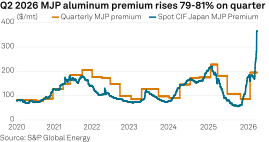
Prior to the escalation of the conflict in the Middle East, market expectations for Q2 MJP levels were at around parity to the Q1 MJP level at $195/mt or slightly higher, supported by expected restocking demand from Japan amid the start of their fiscal year in April.
Offers throughout the negotiations ranged $220-$353/mt CIF Japan. Initial Q2 MJP indications were heard at $220/mt CIF Japan on Feb. 25. Platts later received the news of a second offer at $250/mt CIF Japan on Feb. 26, which was later retracted on March 2. Subsequently, Asian aluminum market observed increasing tightness in supply due to the escalation of geopolitical tensions in the Middle East in early March, lifting renewed offer levels up by $100/mt CIF Japan to $350/mt CIF Japan March 10.
On the supply side, the Middle East conflict is expected to further tighten the global supply of aluminum, lifting global aluminum premiums, especially in Asia. Gulf Cooperation Council is the world's third-largest primary aluminum producing region, with a total output of 6.16 million mt in 2025, accounting for 8.3% of the world's total aluminum output, according to the International Aluminum Institute. Gulf aluminum producers export 3.8 million mt annually, representing around 60% of their annual output.
Qatar aluminum smelter Qatalum, a 50-50 joint venture owned by Hydro and Qatar Aluminum Manufacturing Company, is maintaining aluminum production at 60% of capacity, co-owner Hydro said in a March 12 statement. Meanwhile, Bahrain's Aluminium Bahrain said March 15 that it has shut three lines that represent 19% of its total production capacity of 1.62 million mt/year of aluminum. South32, too, idled its Mozal aluminum smelter in Mozambique after failing to secure power for operations, the company said March 16.
"Concerns will persist about the security of other facilities in the Middle East region and their ability to export while the conflict continues. Shipment delays are inevitable as longer shipping routes must be taken," said Karen Norton, associate director at S&P Global Energy.
Market participants continued to keep a close watch on the Middle Eastern smelters, suggesting that prolonged closure of the Straits of Hormuz would increase the likelihood of further production cuts or shutdowns as aluminum feedstock, alumina, fails to be delivered to smelters in the region. Despite the possibility of alumina deliveries by land from other ports in Oman, some market participants remained skeptical of its feasibility. Idled production could take anywhere from three months to a year to resume, according to sources.
On the demand side in Asia, particularly Japan, market participants noted that demand growth was capped, with demand mostly remaining stable year-over-year. Some, however, believed that restocking activity in the Japanese market was likely to begin in Q2, amid the start of the fiscal year, and that this would deplete main Japanese port stock levels.
Port stocks at main Japanese ports at the end of February stood at 302,300 mt, down 3.17% month over month and 3.54% year over year. The February 2026 main Japanese port stock levels were the lowest observed since November 2024.
Amid the tightening supply of Good Western origin tons from the Middle East and South32's Mozal aluminum smelter, Japanese market participants were heard to have begun seeking alternative supply. Among the potential alternative tons were Indian- and Indonesian-origin, as Indonesia's production capacity is expected to increase.
"Good Western is still preferred," said a trader, "but buyers would need to pay high premiums or begin to accept other brands".
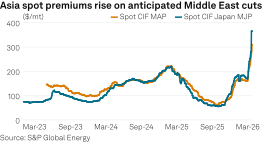
The CIF main Asian ports spot P1020 aluminum premium was assessed at $310/mt plus London Metal Exchange cash, unchanged day over day.
Platts specifications are for all quarterly settlements on a CIF main Japanese port basis, negotiated before the quarter between two unaffiliated counterparties, for P1020/P1020A 99.7% primary aluminum ingot, with payment in cash against documents, for volumes of 500 mt/month or more under annual frame contracts.
