Metals & Mining Theme, Maritime & Shipping, Non-Ferrous
March 06, 2026
FACTBOX: Aluminum prices surge as Middle East war disrupts GCC trade flows

By Staff
HIGHLIGHTS
Trade via Strait of Hormuz at standstill
GCC supplies 8% of global aluminum output
European premiums surge 16%
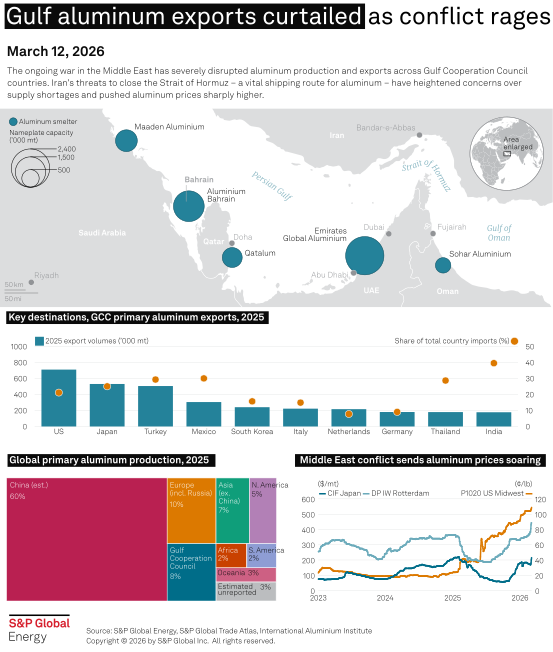
The war in the Middle East has significantly disrupted aluminum production and exports across Gulf Cooperation Council countries.
Maritime traffic through the Strait of Hormuz -- a vital shipping corridor for aluminum -- has effectively come to a standstill, driving up aluminum prices and raising concerns about supply shortages. GCC aluminum production facilities are highly dependent on the Strait for importing raw materials and exporting primary aluminum and its associated value-added products. Extended disruptions to raw material shipments could lead to reduced production rates and further operational shutdowns.
These challenges are further exacerbated by existing supply constraints and the imminent closure of South32's Mozal aluminum smelter in Mozambique, a key supplier to European markets.
Production
- The Gulf region hosts some of the world's largest and most technologically advanced aluminum smelters, including Emirates Global Aluminium in the UAE, Aluminium Bahrain (Alba), Ma'aden Aluminium in Saudi Arabia, Qatalum in Qatar, and Sohar Aluminium in Oman.
- According to the International Aluminium Institute, GCC countries produced approximately 6.16 million metric tons of primary aluminum in 2025, representing about 8% of global output.
- Aluminum smelting is an energy-intensive process. The Gulf's access to abundant and relatively low-cost natural gas has been a crucial driver of the industry's growth and global competitiveness.
- To diversify their economies and add value beyond primary aluminum production, Gulf countries are investing in downstream sectors, including extrusions, flat-rolled products, and fabricated products.
Trade
- Most aluminum produced in the Gulf region is shipped via the Strait of Hormuz to key export destinations including the US, EU, Japan, South Korea, Thailand and Turkey.
- These volumes account for a significant proportion of the overall supply among leading aluminum consumers. In 2025, exports from the GCC represented approximately 21% of total US primary aluminum imports, according to official US customs data. Additionally, GCC-produced flat-rolled aluminum products accounted for about 16% of total US imports in this category.
- GCC countries supplied 19% of the EU's primary aluminum imports and contributed around 5% of the bloc's total imports of aluminum flat-rolled products in 2025, with the majority delivered to Italy and the Netherlands.
- Similarly, the GCC accounted for around 25% of Japan's total imports of primary aluminum in 2025.
- Other countries, including Mexico, South Korea, India, Thailand and the UK, import large volumes of primary aluminum and semi-finished products from the GCC. Taiwan also imports such products from the GCC.
Prices
- European Duty Paid P1020 premiums have jumped nearly 16% since the conflict began, highlighting Europe's "lean market model" exposure to supply shocks.
- European billet premiums have surpassed LME cash plus $700/mt, the highest level since December 2022, after Qatalum and Alba declared force majeure separately to their customers.
- Alternative supply sources from Asia will now face higher freight rates and longer passage times as container ships reroute via the Cape of Good Hope after announcing they would no longer transit the Red Sea and Suez Canal.
- European Duty Unpaid P1020 premium has reached LME cash plus $345/mt IW Rotterdam; however, the market is closely watching to see where the next Asian Quarterly MJP will settle as the key price competitor to Europe.
- US Midwest aluminum premiums -- already the highest in the world by a long margin because of Section 232 tariffs of 50% -- have risen to new records since the war began. Platts assessed the spot 99.7% P1020 US Aluminum Transaction Premium at LME cash plus 106.55 cents/lb ($2,349/mt) plus LME cash, delivered Midwest, net 30-day payment terms, on March 3 and 4, up from 105 cents/lb on March 2 and 104 cents/lb on Feb. 27.
- US market participants expect upward pressure on US aluminum billet upcharges, as US buyers compete with European buyers who were previously dependent on Middle Eastern billet supply. Platts' weekly assessment of the billet upcharge in the US was a premium of 12-14 cents/lb to Platts P1020 MW aluminum Transaction Price.
In Asia, Spot MJP P1020 premiums have risen 36.9% since the conflict began to $230/mt CIF Japan on March 6, amid bullish sentiment around concerns of a supply shortage and higher freight costs to Asia. Spot MJP premiums were last seen at $230/mt in 2015. The most recent offer for Q2 MJP at $250/mt CIF Japan was retracted early morning March 2, following the outbreak of the war in the Middle East. Sellers in the market are taking a cautious approach. The withdrawal of the Q2 offer, which was valid until March 6, sent bullish signals across Asian markets. Given the recent developments in the Middle East, market sources expect renewed offers to be well above $300/mt CIF Japan, with levels eventually settling around $270/mt CIF Japan.

Editor: