Metals & Mining Theme, Ferrous
February 27, 2026
IRON ORE SERIES: Lodestone plans DR hubs in Middle East, India, executives say

HIGHLIGHTS
1.6 billion mt magnetite resource at 25% DTR grade
69.5% Fe concentrate suited for direct reduction plants
Major steelmakers express interest in supply partnerships
The arrival of Simandou's high-grade iron ore has the potential to alter the landscape of the iron ore markets. This is the fifth of a six-part interview series, in which Platts News has talked to magnetite ore producers to discuss their strategy and competitive advantage.
Australia's Lodestone Mines Ltd. aims to develop direct-reduction hubs in the Middle East and India for its South Australian Olary Flats magnetite iron ore project, which is expected to begin operations toward the end of this decade, the company's executives said.
The company has a 1.6 billion metric tons JORC resource, with just over 25% magnetite ore grading in Davis Tube Recovery at Olary Flats, the company's Chairman Gordon Toll told Platts, part of S&P Global Energy.
Lodestone is currently raising $10 million to complete a definitive feasibility study on Olary Flats.
The startup will likely cost around $600 million to initially produce about 3 million mt/year of concentrate if it starts with only one grinding line, and 6 million mt/year if it begins with two grinding lines, Toll said.
The project should commence around 2029, if everything goes as planned, Toll said, adding that about 4 mt of raw iron ore needs to be mined to produce 1 mt of magnetite.
Olary Flats will eventually be expanded in stages to 25 million mt/year of concentrate, Toll said.
"Direct reduction plants in the Middle East and North Africa and India -- the two areas of significant DR growth -- are our target markets given that we can fairly easily produce a product that's about 69.5% Fe," Toll said.
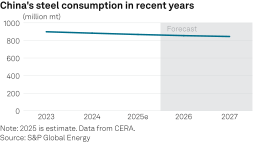
"I don't think China is going to expand much [in steel production], but I do think India will expand greatly, while the Middle East and North Africa region definitely wants to expand -- especially Saudi Arabia, Oman, Kuwait, United Arab Emirates, Algeria, and even Libya where Turkish and Qatari companies are financing things in a big way," Toll said.
For several years, India has maintained its position as the world's largest producer of direct-reduced iron, which has gained prominence for its potential to reduce carbon emissions in energy-intensive sectors like steel.
Export options attract majors
Lodestone plans to initially pump the concentrate slurry to a rail line 40 kilometers from the site and export it through one of several South Australian ports it is currently considering.
However, Lodestone wants Olary Flats to eventually transition from geared bulk carriers to larger Capesize bulk carriers, loaded either from its own port or from barges using its high-volume trans-loading system, with the port also handling material from other companies, Toll said.
This targeted vertical integration strategy is attracting interest from major global steel producers, which Lodestone's executives hope will support Olary Flats' development and future expansion plans.
"This [interest] is mainly driven by the fact that they want to have more confidence over the consistency and quality of supply in their operations to improve their efficiency," Emmanuel Heyndrickx, Lodestone's London-based director of financial strategy, told Platts.
"So, they are expressing an interest to vertically integrate. Where our ultimate plans will lie in the definitive feasibility study may well be shaped by them in terms of what capacity and shipment logistics arrangement they would want to see."
While such companies have constraints in their own significant capital needs, "what we need at the moment is not significant, and they could certainly consummate [a deal]," Heyndrickx said.
Large steelmakers and DRI producers are "expressing interest to be early stage or earlier stage partners to help us align our development to their needs," Heyndrickx said.
"Even if there is no immediate funding from these operators, what is clear is that any form of partnership that we have with an operator will reflect on the financial investor, and they will get great confidence and comfort out of any established relationships because they will see where the value chain is developing," Heyndrickx said.
"There is more and more a drive toward partnerships in these big infrastructure-type plays. So, if we can get funding out of these people directly, that would be fantastic, but if not, the partnership could still grow enormous fruit for us in our fundraising efforts."
