Metals & Mining Theme, Ferrous
February 25, 2026
IRON ORE SERIES: Australia's Yilgarn holds high-grade iron ore potential: Macarthur CEO

HIGHLIGHTS
Macarthur studies Moonshine magnetite project viability
Glencore, Gold Valley agreements boost development
The arrival of Simandou's high-grade iron ore has the potential to alter the landscape of the iron ore markets. This is the third of a six-part interview series in which Platts News has spoken with magnetite ore producers to discuss their strategy and competitive advantage.
Western Australia, which exports most of the world's iron ore, still has plenty of high-grade upside, according to Cameron McCall, CEO and executive chairman of Macarthur Minerals Ltd.
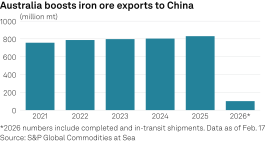
Western Australia has long been the world's largest iron ore exporting jurisdiction, according to S&P Global Commodities at Sea data, thanks largely to major mining in the state's Pilbara region, and exports predominantly lower-grade hematite ore whose quality has been declining of late.
However, Western Australia's Yilgarn region still has plenty of high-grade material that would be of interest to steelmakers, including those in China, where steel output is widely seen as having plateaued but whose demand for iron ore remains significant.
"For both hematite and magnetite [types of iron ore], there are significant projects there" in the Yilgarn, Cameron McCall told Platts, part of S&P Global Energy.
Macarthur Minerals completed a feasibility study in April 2022 on the Moonshine North and Moonshine magnetite deposits within the Lake Giles project in the Yilgarn, which underpins the 237-million-metric-ton maiden ore reserve announced in March that year.
The feasibility study pegged $569 million in start-up capex to produce 3 million mt of 66% Fe magnetite concentrate on a dry-basis over a 25-year mine life.
The broader Moonshine magnetite project has an inferred mineral resource of 1.32 billion mt at 30.1% Fe, according to a 2011 report.
While that 2022 study was hoped to generate productive talks with financiers to get the Moonshine project moving, this has proven difficult given COVID disruptions and interest rates now being higher than they were, McCall said.
"We're now looking at a dry crushing process to potentially upgrade the ore to a salable commodity to be sold overseas to China, where it can be upgraded further to concentrate or pellets. A lot of that is [at] very high-level talks at the moment," McCall said.
"The idea is to get this thing into cash flow as cheaply and as quickly as possible ... and then expand out of cash flow and profits," McCall added.
Glencore support
Macarthur Minerals still has an agreement in place with Glencore, signed in March 2019, for the Lake Giles iron ore project, comprising the Moonshine magnetite and the Ularring hematite projects.
The agreement covers Lake Giles' life-of-mine and includes commercial terms for about 4 million mt/year for the first 10 years, with the option to extend for another 10 years.
The agreement was valued at about $4 billion in revenue over the first 10-year term, McCall said at the time.
Then, in June 2024, Macarthur Minerals signed a binding term sheet with the private group Gold Valley Yilgarn, which was granted the right to extract hematite ore from Ularring.
Under the agreement, Macarthur Minerals will receive A$5 million on the first 1 million mt produced, plus A$5 million on the second 1 million mt, plus A$1 per mt produced thereafter.
Based on the total hematite resource, it amounts to potentially A$90 million in royalties for Macarthur Minerals, according to McCall.
With the royalty agreement with Gold Valley, "MacArthur has significantly de-risked itself," particularly as it looks to develop Moonshine.
"So we're not wearing the exchange rate risk, the market risk or any financing risk" on Ularring, McCall said.
Gold Valley Yilgarn was Macarthur Minerals' largest shareholder with a 24.34% share as of Feb. 4, according to McCall.
This "shows Gold Valley's confidence and commitment to MacArthur Minerals' resources," McCall said.
Macarthur Minerals' agreement with Gold Valley Yilgarn excludes mining of magnetite iron ore from the Moonshine magnetite project.
Separately, Gold Valley also entered into an offtake agreement with Glencore for 100% of the product from the Wiluna West C4 iron ore project, which has a mineral resource estimate of 21.6 million mt at 60.7% Fe, according to Gold Valley's website.
Gold Valley Yilgarn did not respond to requests for comment.
