Metals & Mining Theme, Ferrous
February 24, 2026
IRON ORE SERIES: Yogi project to spur Western Australia magnetite investment: MD

HIGHLIGHTS
Project to produce premium iron ore concentrate
Aligned with green steel, emissions reduction goals
The arrival of Simandou's high-grade iron ore has the potential to alter the landscape of the iron ore markets. This is the second of a six-part interview series, in which Platts News has talked to magnetite ore producers to discuss their strategy and competitive advantage.
FI Joint Venture Pty Ltd.'s Yogi magnetite project will spur investment in Western Australia's unexplored magnetite potential, Managing Director Reza Azimi told Platts, part of S&P Global Energy, in an interview.
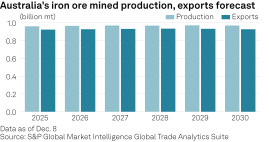
Western Australia is largely responsible for the country's standing as the world's biggest iron ore exporter, albeit mostly from increasingly low-grade hematite ore being mined by majors in the Pilbara region.
The Pilbara region also hosts Fortescue Ltd.'s Iron Bridge mine, which made its first magnetite product in April 2023 with a first run grade of greater than 68% Fe, along with Citic Pacific Mining's Sino Iron mine, which has been producing magnetite since 2013.
Yogi sits in Western Australia's Midwest region, which already hosts the large Chinese-owned Karara mine, which shipped its first magnetite in January 2013, according to Karara Mining's website.
However, Azimi told Platts that Yogi "will generate more attention and motivation toward developing many unexplored magnetite resources in Western Australia."
FIJV has also tapped into the momentum of others intending to develop downstream steel and iron-making projects in the Midwest. To this end, FIJV signed a memorandum of understanding in April 2025 with Green Iron and Steel Australia, which plans to develop green steel production in Western Australia using magnetite-iron-ore concentrate.
This also aligns with the Western Australian government, which has supported value-added industries in the supply chain with its "Made in WA" strategy. That strategy includes backing big batteries, lithium and rare-earth refineries, green iron smelting, and solar and wind farms, according to a February 2025 statement from the state's premier, Roger Cook.
New phase
Studies have demonstrated an attractive rate of return and pilot plant test results "decisively prove that the [Yogi] project is technically and practically doable," Azimi said.
With state and federal environmental approvals now in place, along with Western Australian permits for the mining proposal, mine closure plan and water licensing, Yogi has transitioned into a capital markets and execution phase, he said.
FIJV -- owned by the Hong Kong-based joint venture company Mineral Investment Technology Group, with shareholders in Oman -- plans for Yogi to produce 5 million metric tons per year by 2030, ramping up to 12.5 million mt/y in 2036, Azimi added.
Yogi's expansion beyond the initial production rate is planned in stages, subject to market conditions and the broader development of the Yalgoo iron project, Azimi said.
Current mine planning indicates a life of mine of about 17-18 years, with potential to extend by a further five years as the orebody remains open to the north and south, he added.
Yogi will produce a "premium, controlled-grade iron ore concentrate," which Azimi said is ideally suited for pelletizing, direct-reduced iron production and lower-emissions steelmaking routes.
The project's product positioning "aligns strongly with structural changes occurring across the global steel industry, where producers are increasingly prioritizing higher-grade feedstocks, lower impurity levels and reduced emissions intensity per ton of steel," Azimi said.
Magnetite concentrate is increasingly preferred in DRI and pellet feed applications, especially in regions with access to natural gas or hydrogen, according to Azimi.
Yogi will be partitioned into various segments such as power generation, mining, mineral processing, haulage, transportation and slurry pipeline, each of which could be financed in various ways such as build-own-operate, build-operate-transfer and project financing, Azimi said.
The product will be sold through offtake agreements to help finance the project, he added.
