Metals & Mining Theme, Non-Ferrous
January 26, 2026
US ALUMINUM: Trade uncertainty, supply tightness push Midwest Premium above $1/lb

HIGHLIGHTS
Aluminum imports fall by 25% year over year in 2025: ITA
Buyers await Q1 replacement units, lean on contracts
MOC liquidity rebounds, with premium at record highs
This report is part of a series on impactful trends in the US aluminum market based on S&P Global Energy pricing, news, and analytics.
US aluminum market participants are expecting an influx of imported units to rebuild depleted inventories in early 2026, with the Platts US Aluminum Midwest Premium rising to an all-time high on tight spot supply.
The premium broke the $1/pound level for the first time Jan. 23, assessed at $1.0095/lb plus London Metal Exchange cash, delivered Midwest. Producer, trader, and consumer sources have anticipated a surge to and beyond $1/lb since the start of the year, especially as continued uncertainty over tariffs has spurred importers' reluctance to commit to significant replacement stocks.
Aluminum inflows and orders for aluminum products both decreased at the end of 2025, according to US domestic trade and industry association data. Continued uncertainty around US tariff policies has weighed heavily on early 2026 dynamics, leading most participants to keep spot activity thin and stocks lean.
"Unless you want to take a risk and bring in metal you don't have an order for, you're rolling the dice," a billet consumer told Platts.
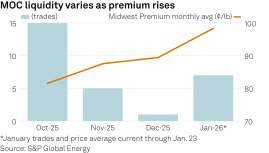
Activity in the Platts Market on Close assessment process for the Midwest Premium rebounded in January after slowing from October through December, but traded volumes remain small, data from Platts, part of S&P Global Energy, showed.
Bullish premium sentiment prevails
Market participants anticipate the premium will remain elevated throughout the first quarter of 2026 until new P1020 aluminum arrives in the US, with spot buyers generally accepting prompt shipments at elevated costs.
"I expect full Armageddon again," one trader said at the start of Q1, emphasizing widespread supply tightness.
Midwest Premium levels climbed steadily throughout the second half of 2025 as the market absorbed the full impact of doubled import duties imposed mid-year. Platts assessed the premium at 91.05 cents/lb Dec. 31, up 55% from the assessed level June 4 when the 50% tariffs went into effect.
Although a rising premium has increased the feasibility of selling into the US for global suppliers since late 2025, engaging in spot business with US customers has been considered risky as the longer-term tariff situation remains unclear.
US imports of unwrought, unalloyed aluminum were down 25% year over year in 2025, according to the International Trade Administration's Aluminum Import Monitor portal.
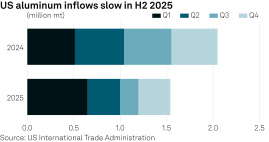
About 1.01 million, or 70%, of the 1.54 million mt of aluminum imported in 2025 came from Canada, according to ITA data. India and the United Arab Emirates were the only other countries, aside from Canada, that were responsible for more than 100,000 mt of US aluminum inflows in 2025.
Canada also accounted for 70% of US primary aluminum imports in 2024, according to data from S&P Global Market Intelligence.
With US-Canada relations uncertain and European aluminum premiums elevated at the start of 2026, most available Canadian units have been committed to Europe for the rest of Q1. The US is instead waiting on shipments from parts of the Middle East, Asia, and Australia, among other places, that were purchased in late 2025, according to buyers and sellers.
As the rising LME price supports base metals globally, an elevated European aluminum premium has helped draw units overseas. The Platts Daily Aluminum Duty Paid In-Warehouse Rotterdam Premium was assessed at a midpoint of $350/mt Jan. 23, roughly a one-year high.
Steady demand amid tariff trepidation
US demand discussions to end 2025 and begin 2026 were largely unchanged, with buying appetite talked steady. The average number of orders recorded by domestic aluminum producers from January through November 2025 was within half a percentage point of the 2024 recorded orders, according to the most recent Aluminum Association statistics.
Aluminum orders, however, trailed off by the end of 2025, the data showed. November orders for flat roll products — sheet, plate, can stock, and foil — decreased by 11.4% month over month, while orders for extruded products fell 21.9%. Compared with November 2024, total orders were down 6.1%.
Gauging demand beyond the immediate term is challenging, especially since the outlook depends on evolving trade policies, market participants have said. Sources speculated over a potential increase or decrease in the aluminum duty, as well as whether the duty might be eliminated altogether.
Another variable is whether any changes would be applied across the board. For example, some wondered whether the US would agree to a quota-based system with at least some countries, allowing a certain volume of aluminum imports at a lower tariff — likely 25%, the rate in place from 2018 until mid-2025.
Many participants have chosen to hold onto existing stocks and keep spot business to a minimum, managing inventories closely, even with overall warehouse estimates well below the 200,000 mt level. No trades with a volume higher than 300 mt have been reported in the MOC since Nov. 18, Platts data showed.
The Platts Midwest Premium forward curve, launched Jan. 2, remains in backwardation.
Market players are mostly relying on contractual agreements and preexisting supplier relationships to meet near-term demand, seeking greater flexibility with contracted volumes while accepting that discounts are fewer and farther between.
Discussions for 2026 contracts began earlier and ended later than in previous years, as customers sought annual discounts that were no longer feasible, sources said. Many large consumers were insulated by multiyear contracts going into 2026 and maximized flexibility on those agreements.
"We got lucky and didn't have to book at premiums this year because of that," a consumer told Platts.
Although market sources spoke in late 2025 of seeking shorter contract terms, such as quarterly or even monthly, 2026 discussions indicated that most agreements remained unchanged.

Editor: