Crude Oil
May 11, 2026
Japan PM says no immediate need for extra energy conservation amid Middle East conflict
By Takeo Kumagai, Gawoon Vahn, and Leon Wong
Editor:
HIGHLIGHTS
PM says important to continue summer, winter measures
ENEOS to receive 283,041 barrels of Azeri Light crude
Refiners diversify imports beyond Middle East
Japanese Prime Minister Sanae Takaichi said May 11 that the country does not see any immediate need for additional energy conservation measures amid the ongoing Middle East conflict.
"At this point, I do not think we are at a stage where we need to ask the public for further, more drastic conservation measures," Takaichi told the House of Councillors' Committee on Budget session.
"We must keep daily life, medical care, and various sectors running, as well as industry and the economy. If we push too hard, there could be various impacts, including the possibility of panic-buying if people believe they won't be able to purchase fuel for a long time," she said.
"Therefore, I do not think it is appropriate to make further requests at this time. However, we will continue to closely monitor the situation in the Middle East, consider all possibilities, and respond flexibly as circumstances require."
The call to the public to conserve energy is made every summer and winter when energy demand increases, Takaichi said.
"Regardless of the situation in the Middle East, I believe it is important to continue these efforts over the medium term," she said.
Japan's petroleum reserves were equivalent to 205 days of domestic consumption as of May 8, comprising 121 days in national oil reserves, 83 days in privately held reserves and one day in a joint crude oil storage program with oil-producing countries, according to the latest data released May 11 by the Ministry of Economy, Trade and Industry.
Diversified imports
METI said May 11 that a tanker carrying Azerbaijani crude oil for ENEOS is scheduled to arrive in Yokohama as early as May 12, marking the first tanker carrying Central Asian crude to reach Japan since the Middle East conflict began at the end of February.
An ENEOS spokesperson confirmed May 11 that it will receive about 45,000 kl, or 283,041 barrels, of Azeri Light crude on the Bright Horizon at its 153,000 b/d Negishi refinery in Tokyo Bay.
Japan is scheduled to receive a total of 59.169 million barrels, or 1.909 million b/d, of crude oil in May, of which US barrels are expected to account for 13.367 million barrels, or 431,184 b/d, according to S&P Global Commodities at Sea data as of May 11. This compares with Japanese imports of 2.403 million b/d of crude in May 2025, according to METI data.
In addition, the Voyager, carrying 750,377 barrels of Sakhalin Blend loaded from Russia's Prigorodnoye port, arrived at Kikuma, western Japan, on May 5, according to CAS data, marking Japan's first intake of Russian crude cargo since June 2025.
A spokesperson for Taiyo Oil has confirmed that it received a cargo of Sakhalin Blend crude as part of its efforts to diversify crude oil procurement in response to the effective closure of the Strait of Hormuz, at the request of the Japanese government.
The spokesperson said loading operations took place over May 5-6, but declined to specify the volume, citing contractual reasons.
Prior to that, the last time Taiyo Oil received a cargo of Sakhalin Blend crude was in June 2025, when it received 600,000 barrels, the country's first delivery of Russian oil since early 2023.
Sakhalin Blend is a light, sweet crude produced as a by-product of LNG production from the Sakhalin-2 project, managed by Sakhalin Energy, which is majority owned by Russia's state-owned Gazprom. Minority stakes are held by Japan's Mitsui & Co. and Mitsubishi Corp.
Shipments of Sakhalin Blend to Japan are not subject to the G7's price cap on Russian oil because of their critical importance to stable LNG production from the project.
The US has also exempted crude oil under the Sakhalin-2 project from sanctions. In late 2025, the US Treasury's Office of Foreign Assets Control said the exemption for Japan's maritime transport of crude oil from the project for imports into the country had been extended to June 18, 2026.
No complacency
Despite any optimism about the outlook for tanker flows from the Persian Gulf, the Japanese refining industry's need to reduce its heavy dependence on Middle Eastern crude remains firm, as geopolitical conditions in the region are highly fluid, feedstock inventory managers at three major Japanese refiners, including ENEOS, told Platts during market discussions and engagement sessions over May 7-11.
"Normal tanker traffic flow in the Persian Gulf would be fabulous," said a feedstock inventory manager at ENEOS. "However, problems can recur unexpectedly at any time, so it's crucial to significantly increase crude procurement from non-Middle Eastern suppliers, such as the US."
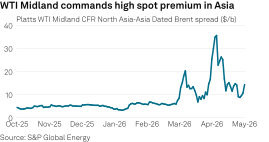
Among recent spot market deals concluded in Asia, Japan's second-largest refiner, Idemitsu Kosan, purchased a VLCC loaded with 1.4 million barrels of WTI Midland and 600,000 barrels of Mars Blend crude for August delivery at a premium of more than $20/b to Platts front-month Dubai, traders based in Singapore and feedstock managers at South Korean, Taiwanese, Japanese and Thai refiners with close knowledge of the matter told Platts.
Elsewhere, Cosmo Oil received a Suezmax cargo of light sweet US crude on April 27 after the tanker took the shorter Pacific Ocean route via the Panama Canal, Platts reported previously, citing a feedstock inventory manager at the refiner.
In the first three months of the year, Japan imported 80,948 b/d of mostly WTI Midland and West Texas Light crude from the US, more than double the 39,071 b/d recorded in Q1 2025, the latest data from METI released April 30 showed.
The Middle East accounted for 94% of Japan's crude oil imports in 2025, according to METI data.
