Maritime & Shipping, LNG
May 06, 2026
Turkish gas and LNG imports grow, targets to become a regional gas hub
By Komar Mohamadpor and Geraint Moody
Editor:
HIGHLIGHTS
Turkey signs 10 LNG deals, eyes hub status
LNG imports at 6.9MMt so far in 2026, up from 6.57MMt in 2025
Turkey is expected to play a pivotal role in delivering a diversity of gas and LNG this summer to Central, Eastern Europe and the Balkans, as it solidifies its place as a regional hub, traders said.
Turkey signed around 10 deals late last year, securing cargo supply for the short- to medium-term. Turkey has continued to secure supplies for its own domestic needs, as well as aiming to be the regional gateway of supply for the gas and LNG market, as Europe looks to phase out Russian gas and LNG.
| Supplier | Volume (Bcm/year) | Duration (years) | Start Date |
| BP | 1.6 | 3 | 2026 |
| Cheniere | 1.2 | 1 | 2026 |
| Shell | 0.8 | 3 | 2026 |
| SEFE | 0.6 | 3 | 2028 |
| JERA | 0.6 | 1 | 2026 |
| ENI | 0.5 | 3 | 2028 |
| Equinor | 0.5 | 3 | 2026 |
| Hartree | 0.3 | 2 | 2026 |
| Woodside | 0.64 | 9 | 2030 |
| Mercuria | 4 | 20 | 2026 |
BOTAS also secured around 5 million mt/year through deals with Exxon and Shell in 2024.
"LNG has transitioned from backup source to a crucial element of diversification strategies due to geopolitical tensions, price volatility, and supply disruptions from pipeline suppliers," analysts at CERA said. "We forecast LNG demand to nearly double to 19 MMtpa by 2050, driven by pipeline contract losses and growing export needs for neighboring markets... Turkey is leveraging its geographic advantage and diverse LNG portfolio to supply gas to EU markets."
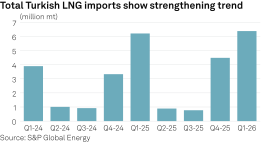
Domestically, Turkey has imported 6.90 million mt of LNG in 2026 so far, according to S&P Global Energy CERA data. This compares to the same period last year where imports stood at 6.57 MMt and 4.41 MMt imported in 2024, over the Jan. 1 to May 6 period.
Turkey imported a total of 12.38 MMt of LNG in 2025 and imported 9.17 MMt in 2024, marking a 35% increase year on year.
"In the South, TurkStream [pipeline] is a big question mark," a European gas trader said, commenting on the uncertainty over pipeline flows as contracted volumes conclude this year. "We are watching that to see if the flows are maintained... They are receiving fewer Iranian volumes, taking more Russian volumes."
Recent increases in demand have also been catalyzed by pipeline disruptions from Iran. Turkey has a domestic gas demand between 50 billion cubic meters and 60 bcm/year, traders said. While their 2025 LNG imports amounted to nearly 17 bcm, they also import gas volumes from Iran, Russia and Azerbaijan. Turkey relies heavily on imports to meet this need as domestic production accounts for only 4% of demand.
Its geographical location makes it a hotspot for gas imports, as its proximity to major gas producers such as Russia, Azerbaijan, and Iran enables robust pipeline imports to meet demand.
Alongside this, Turkey has invested in its import infrastructure to enhance its role as a key transit hub for Europe, with LNG being used as a source of flexible supply to meet high-demand seasons as well as a method of decreasing reliance on pipeline imports.
Turkey renewed their pipeline contract with Russia to import around 21.75 bcm of gas/year through the TurkStream and Blue Stream pipelines. At the same time, traders said Turkey is currently negotiating the renewal of its pipeline contract with Iran, which amounts to 10 bcm/year, expiring in July. Turkey also imports around 6 bcm of pipeline gas from Azerbaijan.
"I think the role of Turkey is key," the European gas trader said.
Turkey as regional gateway
In addition to the import deals, the country has also signed agreements to become a regional supplier of gas and LNG into the rest of Europe.
Most recently, DEPA was awarded the Bulgargaz tender for 1 terawatt-hour of LNG to be regasified at the Turkish port of Marmara over the summer of 2026 and delivered to Bulgaria.
While Turkey imports gas from Azerbaijan, Russia and Iran are also able to re-export the LNG imports and pipeline volumes. The Russia-Turkey TurkStream pipeline runs from Russia to Turkey, then onward to Europe through Serbia and Bulgaria. Turkey also reroutes volumes to Slovakia from TurkStream.
The flows from Turkey to Bulgaria are able to feed volumes to Central and Eastern Europe and the Balkans.
Turkey also exports pipeline volumes to Moldova and is able to export gas to Greece through the Southern Gas Corridor. Through pipelines like TurkStream and TANAP, Turkey transmits Russian and Azerbaijani gas to Southeastern Europe.
Turkey has signaled a strong intent to expand the Southern Gas Corridor, noting that the core infrastructure required to potentially double gas exports to Europe is already in place.
With domestic demand expected to grow and Turkey looking to re-export volumes onward to Europe, traders expect demand over the next few years to continue to grow.
CERA data forecasts LNG imports into Turkey at 16.6 bcm for 2026, growing to 17.95 bcm in 2027 and peaking at 18.88 bcm in 2028.
"Turkey can be a home with US, Algeria, Russia, Nigerian, Azeri and other origins of LNG and gas flowing in to make a pot of supply to sell to Europe," an LNG trader said. "The price will be high for regasified LNG, which then transmits through Turkey and onto the rest of Europe, but it will be a way to secure supply."
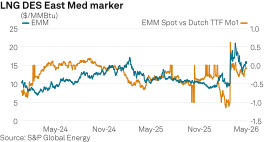
Platts, part of S&P Global Energy, assessed the DES East Mediterranean LNG marker for June at $16.007/MMBtu, and at a 6.5-cent discount to the Dutch TTF, or a 20-cent/MMBtu premium to the DES Northwest European LNG marker.
