LNG, Natural Gas
May 04, 2026
July JKM-NWE spread widens as Asian LNG pull strengthens, European injections lag
Editor:
HIGHLIGHTS
JKM-NWE derivatives spread widens to $1.940/MMBtu in April
Northeast Asian summer demand firms, led by southern China
European injections lag as backwardation keeps storage uneconomical
The July JKM-NWE derivatives spread widened in the last two weeks of April as prolonged risks to LNG flows via the Strait of Hormuz reinforced the pull toward Asia, while weak European storage economics continued to cap Northwest European gas prices.
Platts, part of S&P Global Energy, assessed the spread at $1.940/million British thermal units at the April 30 London close, 11 cents/MMBtu higher from April 16 -- the start of the June pricing period -- reflecting expectations that Pacific basin demand could outpace European demand in the coming months.
This compares with a narrower spread of 69.1 cents/MMBtu over the same period last year and $1.195/MMBtu in 2024.
A wider JKM-NWE spread typically strengthens the pull for flexible Atlantic basin LNG cargoes into Asia. The Platts-assessed East-West arbitrage for US-sourced cargoes via the Cape of Good Hope reached an eight-week high of minus 30.5 cents/MMBtu on May 1, pointing to improved eastward arbitrage economics, according to Platts data.
Northeast Asia-based LNG traders said the spread remains structurally supported by geopolitical risks, as a sustained disruption to Strait of Hormuz transits is likely to tighten supply into Asia, where Middle East volumes are heavily concentrated.
At the same time, sentiment for Northeast Asian summer demand is gradually firming, particularly across weather-sensitive regions such as South China, according to several Asia-based traders and analysts.
"The tone among Chinese buyers has shifted, from selling to trying to buy and secure supply for domestic needs," a source familiar with the matter said, pointing to increased buying interest from southern regions.
Additional supply-side risks are also emerging. In Australia, Offshore Alliance members on April 24 endorsed protected industrial action at the INPEX-operated Ichthys LNG facility, allowing strike action to begin from May 7.
In contrast, Europe's restocking activity has yet to gain traction, limiting support for Northwest European LNG prices and contributing to the wider spread. Two Singapore-based traders noted that injections remain uneconomical under current market conditions.
"Europe will only inject if the curve is in contango," a Singapore-based trader said. "Right now, demand is weak and there are no subsidies, so there is little incentive to inject."
"Currently, since arbitrage is open, my understanding is that regasification players who operate solely based on economic considerations do not have the incentive to increase their inventories (because they can bring cargoes to Asia)," another Singapore-based LNG trader said.
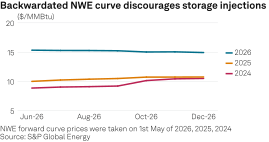
The Northwest European gas forward curve remained in backwardation on May 1, with prompt contracts for June and July assessed at $15.316/MMBtu and $15.339/MMBtu, respectively, above winter values of $15.054/MMBtu for December and $14.932/MMBtu for January 2027.
Asian summer demand outlook
Despite the stronger July spread, prompt Asian spot buying has remained measured, with market participants awaiting clearer weather signals and certainty on supply risks.
"Asian markets may need to procure more cargoes, especially when summer months arrive. They can't stay on the sidelines for too long," an LNG supplier said.
Weather forecasts suggest upside potential for regional demand. Japan's central and southern regions are expected to see a 60% probability of above-normal temperatures in July, with northern regions at 50%, according to the Japan Meteorological Agency.
South Korea is similarly forecast to experience above-normal temperatures with a 60% probability, according to its meteorological agency.
China's summer temperatures will be above normal nationwide, according to the National Climate Center, with severe early-summer heatwaves in North China and mid-summer droughts in southern and southwestern areas.
Several Singapore-based participants expect the direction of the July spread to remain dependent on the weather, with stronger conviction likely once Northeast Asian temperatures rise and demand becomes more pronounced.
"It is likely a hot summer in Asia because of the super El Niño. Qatar will be out of the market for a while. I think the market is strong basically," the second Singapore-based LNG trader said.
