LNG, Natural Gas
April 30, 2026
Two months into war, upside risks loom for European gas market
By Matt Hoisch and Aly Blakeway
Editor:
HIGHLIGHTS
Analysts vigilant for summertime demand hike
EU LNG imports beginning to dwindle YOY: CERA
Market watchers expect accelerated shift from gas
Two months into the Iran war, Europe has evaded the record price surges that beset the regional gas market during the last energy crisis in 2022, following Russia's full-scale invasion of Ukraine. However, with trade out of the Persian Gulf still dramatically diminished, market watchers warn the continent remains exposed to upside risks as summer approaches and, with it, the prospect of a cross-continental swell in demand.
So far, Europe has benefited from significant demand destruction elsewhere. While the war has effectively cut off about 20% of global LNG supply, EU imports have held broadly steady. Parts of Asia, on the other hand, have cut back dramatically. China, for instance, recorded a 19% year-over-year slide in March LNG imports, government data showed.
"We've been lucky that Northeast Asian demand has been weak," one LNG trader said.
A second trader agreed that the demand response has been vital to counter the supply squeeze.
"Everyone is talking about the supply curtailment, but there is a demand curtailment too, so NWE [Northwest Europe] and JKM [LNG] prices to me are fair value given how much demand is destroyed right now," a second LNG trader said.
Platts, part of S&P Global Energy, assessed the JKM benchmark for LNG cargoes delivered into Northeast Asia at $18.309/million British thermal unit on April 30, up 8.3% day over day. The DES Northwest Europe LNG marker was last assessed at $15.719/ MMBtu on April 29, up 7.9% day over day. While both indices remain above pre-war levels, they have subsided from the highs reached in the early weeks of the conflict.
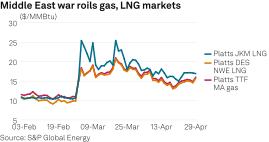
Optimistic expectations have also helped temper further price rises, according to analysts.
"The majority of the market participants are expecting the conflict to end before the summer," Moutaz Altaghlibi, a senior energy economist with ABN AMRO, told Platts in a recent interview, adding, "So they are not pricing in, really, the [full] shock."
Analysts at HSBC characterized the elevated-but-not-astronomical price environment as a symptom of "market complacency" in an April 21 note on gas markets, warning that possible bullish pressures remain "underappreciated."
"Near term, we see a multitude of upside price risks that could significantly amplify the market tightness," they said.
Storage needs
One major concern is a widespread surge in summertime demand. Europe already needs to refill gas storage from recent lows ahead of winter. Heatwaves in Asia could intensify demand there and deepen cross-basin competition for more scarce LNG cargoes.
European leaders have homed in on gas restocking as a primary lever to temper price rises. EU Energy Commissioner Dan Jorgensen has pushed member states to lower their storage fill targets to 80% from 90%, and the European Commission plans to coordinate filling among member states to avoid overlapping demand, raising prices further.
The continent is entering the filling season with stocks lower than at the same time in recent years. EU-wide storage was filled to 32.2% as of April 28, according to the latest data from Gas Infrastructure Europe. At the same time in 2025 and 2024, stocks were filled to 39% and 62%, respectively.
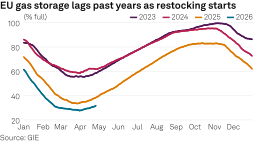
CERA analysts project European storage will fill to around 80% by the end of October, according to an April 27 report. However, this follows from a base case scenario assuming a steady resumption of Hormuz transit by June 1. Extended disruptions would dent global LNG supply more and further tighten markets.
"The more we move towards the summer and the longer the conflict stays, I think the market reaction will get more volatile," ABN AMRO's Altaghlibi said.
Europe is starting to see a growing supply-side impact.
EU LNG imports actually rose slightly year over year in March, CERA data showed, supported by cargoes that were already en route when the war began in late February. Now, that buffer is gone. April imports so far are down about 6.9% from 2025, CERA data showed.
"I don't see a physical shortage for gas -- at least for the time being," Altaghlibi said, adding, "If the conflict prolongs toward the summer, then things could get worse."
Longer-term shifts
Beyond the barrage of near-term challenges, analysts also expect the Middle East crisis to hasten Europe's turn from gas -- a trend that has largely persisted since the 2022 energy crisis.
"It will mostly accelerate trends that we've seen since 2022," Ben McWilliams, an affiliate fellow focused on energy and climate policy at the think tank Bruegel, told Platts. "It doesn't look like it's going to be the same shock as 2022, but I think it will basically accelerate the transition away from gas," McWilliams added.
EU and UK gas demand in 2025 totaled 394 Bcm, according to data from S&P Global Energy CERA, down about 14% from 2021, when demand was around 461 Bcm.
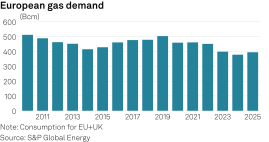
McWilliams's view squares with that from Brussels, where the European Commission has been pushing for a faster expansion of domestically produced, low-carbon energy in response to the war.
"The way forward is obvious, we must reduce our overdependency on imported fossil fuels and boost our home-grown, affordable, clean energy supply," EC President Ursula von der Leyen said in an April 29 speech to the EU parliament.
McWilliams highlighted reducing household gas demand as a possible focus, via measures such as further promoting heat pumps and energy efficiency interventions.
"That's really the sector of society that you want to protect from these shocks," he said, adding, "That's more a hope from me, but I also expect that governments will take that message, and, in terms of household natural gas demand, we'll see more and more structural measures to reduce that."
When it comes to electricity, a significant share of Europe's gas-for-power use goes to fill shortfalls from intermittent renewables. Expanding storage, such as batteries, could help lower that demand, Altaghlibi explained.
"That could also be accelerated in order to reduce your reliance on gas earlier," he said.
