Natural Gas, LNG
April 30, 2026
Narrow LNG-TTF spread limits European terminal utilization
By Komar Mohamadpor and Phoebe Davies
Editor:
HIGHLIGHTS
NWE LNG utilization falls to 58%
Narrowing economics between LNG and gas hubs
April NWE imports at 5.8 million mt
A narrowing spread between Northwest European LNG and Dutch TTF gas hub prices has led to lower utilization across terminals as traders monitor lower regas economics and an unfavorable spread across the European gas and LNG forward curves.
Platts, part of S&P Global Energy, assessed the DES Northwest Europe marker for June at $15.719/million British thermal units April 29, up $1.55/MMBtu day over day, and at a 28.5-cent discount to the June TTF hub price.
This was the narrowest discount seen since the 17.5 cents/MMBtu on March 20 and compared with the 72.5 cents/MMBtu discount seen in this period last year.
Narrow LNG-TTF spreads relative to the fixed and variable costs at Northwest European terminals have led to lower utilization across NWE LNG import facilities.
Utilization across Northwest European countries -- Northern France, Northern Spain, Belgium, the UK, Germany and the Netherlands -- was recorded at 58% in April, according to S&P Global Energy CERA data as of April 30.
This, compared with the 74% utilization in March and 63% in April 2025, the data showed.
Notably, utilization at Bilbao fell from 120% to 68% over March and April, according to CERA data. At the same time, utilization dropped from 77% to 16% at Dragon; South Hook saw a drop from 52% to 15% and Wilhelmshaven saw utilization drop from 75% to 46% over March to April.
While the UK typically sees lower utilization over summer due to limited demand, utilization across NW Europe ports declined due to narrowing economics between LNG and gas hubs, traders said.
This translates to lower imports across the NW Europe LNG market. Imports into Northwest Europe in April stood at 5.8 million metric tons, according to CERA data as of April 30.
This compares with the 7.1 million metric tons in March and 6.05 million mt in April 2025.
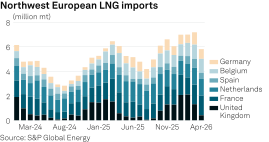
LNG-TTF spreads have continued to narrow since the escalation of the war in the Middle East. Given that spreads are narrower month over month and year over year, traders have seen lower utilization at NWE terminals, as spreads are out of the money relative to regasification costs.
"Breakeven at Zeebrugge is around 50 cents/MMBtu and similar at Ravenna, around 40-50 cents/MMBtu, so you can see that utilization has dropped as the LNG-TTF differentials are narrow," an LNG trader said.
According to the terminal operator Fluxys LNG Tariffs, a slot available for M+1 and M+2 is Eur626,101.91, which translates to Eur0.67/MWh, or around $0.23/MMBtu for the unloading, storage and regasification. This would be irrespective of other variable fees, such as 1.3% gas-in-kind.
A second trader added: "This will go on until real send-outs drop and Europe realizes it needs to start buying to fill storages ... for as long as the Strait of Hormuz doesn't reopen."
Outlook on NWE-TTF
Sentiment remains mixed on the outlook for LNG-TTF spreads. As competition heats up between the Atlantic and Pacific basins for additional spot cargoes, traders see that DES NWE LNG prices may have to rally to keep Europe attractive as a destination for flexible spot cargoes.
"Either TTF will have to rally, or the DES NWE will have to flip to a premium so that Europe can compete with JKM," a third trader said.
As Europe and Asia look to battle it out for spot cargoes, given around 20% of global LNG supply has been cut from Qatar and Abu Dhabi, traders are expecting strong prices over the summer as Europe looks to refill its underground storage and Asia looks to pull in cargoes to satiate domestic demand for its cooling needs over the summer.
On the other hand, traders argue that unless the LNG-TTF spreads widen out and the forward curve flips from the current flat to backwardated structure to a contango, there will be little incentive for players to procure LNG and refill their underground storages.
"If the breakeven is at 50 cents for terminals in NWE and the Med, then the LNG-TTF differential needs to widen at least that much for players to start using their slots again," the second trader added. "We also need the contango to form to incentivize storage injections."
Imports to the broader European region averaged 491 million cubic meters/day over the past 30 days, just 2% lower year over year, CERA analysts said in a report. However, with stocks 13% below the five-year average at the end of March and limited upside potential from non-LNG sources, the European market will struggle to maintain an optimal storage injection rate until the global LNG supply balance normalizes, the report showed.
"In our base-case scenario, assuming a normalization of global LNG supply later in the summer, we expect storage injections to increase progressively as we approach next winter, with stock levels reaching 80% by the start of the next heating season," the analysts added.
While some participants argue that flat prices are still too weak to pull cargoes away from Asia, DES NWE therefore needs to price higher relative to TTF to compete. Others argue that the NWE-TTF spread needs to weaken further to incentivize buyers with regas capacity in Europe and maintain a steady flow of injections.
"I don't think TTF Q3 is really pricing the disruptions in supply ... seems too low the TTF price considering the state of the storage," another trader said.
Platts assessed the DES NWE derivatives contract for Q3-2026 at $15.233/MMBtu on April 29, at a 33.7 cents/MMBtu discount to TTF.
