LNG
April 23, 2026
Atlantic LNG players sell regas slots amid unfavorable spreads
By Clio Ho, Aly Blakeway, and Phoebe Davies
Editor:
HIGHLIGHTS
Three Zeebrugge slots in May offering for resale, versus five for April
March Zeebrugge terminal utilization hits 100%
DET sells short-term Brunsbuttel regas capacities
Atlantic players have been selling prompt LNG regas slots on the secondary market as LNG-TTF spreads remain out of the money for some Northwest European terminals, traders said.
Given the narrow spreads between DES LNG and domestic gas hub prices in Europe, some primary capacity holders have been offloading slots to recoup some of their costs and manage LNG-TTF spreads that are out of the money, several European-based traders said.
"The majority of the 5 slots in April, offered on the secondary market, have been booked and used for," Terminal operator Fluxys told Platts April 23. "In the meantime, we've published on our EMIX platform 3 "slots" in May for unloading, storage, and regasification operations at Fluxys Zeebrugge LNG Terminal, on behalf of a user with long term capacity at the Zeebrugge LNG Terminal."
For April, the five secondary-market regasification slots at Belgium's Zeebrugge LNG terminal have been sold with multiple market sources identifying the original user as QatarEnergy.
The regas slots available for resale fell to three, suggesting that long-term terminal users would use their two slots for regas.
There is some market talk that the first cargo from Golden Pass is heading to Zeebrugge.
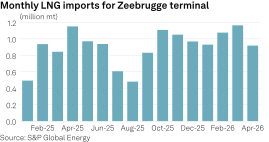
The Zeebrugge terminal is one of the busiest LNG import terminals in Europe. Together with Gate in the Netherlands, South Hook in the UK and Dunkirk in France, these terminals could receive over 1 million metric tons/month.
In March, the Zeebrugge terminal operated at 100% of its regasification capacity, receiving 1.17 million mt of LNG, according to S&P Global Commodities at Sea data.
"In general, we notice a very strong usage of the Zeebrugge Terminal, with LNG cargoes from multiple countries and multiple continents arriving over the last weeks," Fluxys said.
Fluxys said this is at the regulated tariff of the Zeebrugge terminal, so Eur625,000 for a standard cargo, including unloading, storage and regasification. The Eur620,000 equates to around $0.21/million British thermal units for a standard 3.5TBtu cargo.
Meanwhile, in Germany, in its latest marketing round on April 14, Deutsche Energy Terminal successfully completed the auction of short-term regasification capacities at the Brunsbüttel terminal.
The offered capacities for LNG storage, regasification, and grid send-out for the period over June-August were marketed at an average price of Eur0.20/MMBtu. This was about 23-24 cents/MMBtu.
The remaining capacity for the year will be offered at a later stage. A corresponding announcement will be made by DET in due course.
Narrow LNG-gas economics
"It's a weird market; many capacity holders are selling their slots at discounts and trying to get rid of them as much as possible," an LNG trader said.
Another trader said, "Yes, lots of slots are being offered into the secondary market. Players are trying to recoup some of the sunk costs, and the current LNG spreads are out of the money. Plus, cargoes are going to Asia anyway."
"Southeast Asia [is] buying what they must as inventories [are] lower now," a different market participant said.
Platts, part of S&P Global Energy, assessed the DES Northwest European marker for June at $14.556/MMBtu on April 22, a 39.5-cent/MMBtu discount to the Dutch TTF gas hub.
Another trader said because "netbacks are low" in the minus 60 cents/MMBtu region, there is "little value to buy" in some regions, so the "best is Belgium at the moment."
"Slots in Spain are transferred from time to time, but no premium can be applied with respect to the purchasing cost at regulated tenders," a different LNG trader said.
Traders said total fixed and variable costs in Northwest Europe range from 60 to 90 cents when accounting for regasification costs, storage, unloading, grind injection, gas-in-kind, ETS, boil-off, and other components.
"Some traders will consider a portion of these as sunk, if there is an incentive from utilities to keep flows going, or you have a short you need to fill, then you will use the slot in any case," a third trader said. "But there are offers on the secondary market as players are canceling slots given the [LNG-TTF] spreads are out of the money."
"Breakeven is probably 30 to 40 cents in NWE and 50 to 60 cents in parts of the Med, so [LNG-TTF] discounts need to be below that," the third trader said.
The narrow LNG-TTF spreads relative to regas costs are being reflected in European imports. Utilization across Europe was lower month over month, with European utilization standing at 36% so far in April, S&P Global Energy CERA data showed over April 1-23.
This compares with 44% utilization in March and 40% in April 2025 over the same 1-23 period.
This translated into 7.83 million mt being imported into Europe in April this year, versus 8.4 million mt in April 2025.
The current NWE-TTF assessment is minus 39.5 cents/MMBtu, compared with the Platts-assessed NWE-TTF spread of minus 72.5 cents/MMBtu as of April 22, 2025.
"Some prompt slots in Spain were going for 20 cents in Q1; it was about 500,000 euros, which is expensive considering the other costs on top," another trader said.
Further down the curve, LNG slots in Spain were sold at about Eur400,000 for April 2027 delivery, around 13 cents/MMBtu.
