Maritime & Shipping, Dry Freight
April 10, 2026
Panama Canal congestion worsens as LNG carriers crowd out dry bulk
By Cresida Rodrigues and Sabiha Makda
Editor:
HIGHLIGHTS
LNG carriers dominate Panama Canal slots
Dry bulk vessels face waits up to 30 days
Auction prices reach $700,000-$800,000
Panama Canal congestion intensified in early April, with LNG carriers booking up eastbound slots and some vessels facing worst-case waiting times of up to five weeks, according to regional port agents and brokers.
Only three LNG carriers have transited the canal so far this month, despite 13 being scheduled, as unladen ships return from Asia and loaded shipments remain steady. Slot availability for unbooked vessels is now pushed into May, and market participants expect elevated congestion to persist into late Q2, tightening effective vessel supply and supporting freight rates
Slot availability and operational constraints
According to a London-based dry analyst, "the next available first-come, first-served slots for Super vessels are quoted around May 24, and for Regular vessels around May 8. Scheduled maintenance in the old locks from April 7–9 has reduced daily slots, and no auctions will be offered for Supers and Regulars during the maintenance period, according to Advisory 06."
A Panama-based port agent said market chatter suggesting a "five week" figure appears to be an upper-end, worst-case estimate rather than a typical or formally published figure, but added that unbooked First Come First Serve waiting times have lengthened materially and 18 - 30 days is common in many cases, with 4 plus week waits possible if arrivals coincide with LNG-heavy periods or low water‑level constraints. The agent also said LNG carriers are prioritized operationally and tend to move under booked or auctioned capacity, reducing residual availability for other segments.
Maintenance update
According to the Panama Canal Monthly Report released March 19, scheduled maintenance at the Gatun Locks was carried out from April 7 until April 9.
"This maintenance has now been completed, and vessel waiting times are expected to decrease significantly on a day-by-day basis, gradually returning to the Canal's normal operational volume. Nevertheless, we anticipate the possibility of additional vessel arrivals in the coming days as a result of the ongoing conflict in the Middle East, which could temporarily influence traffic levels," the port agent said.
Dry bulk carriers feel the brunt as auctions soar
Looking at broader LNG routing signals, 35 of the 38 US LNG cargoes exported to Asian destinations in March used the Cape of Good Hope, according to CAS. While LNG and higher-value segments compete for canal capacity, dry bulk carriers are reporting stronger disruption and higher costs, market participants said.
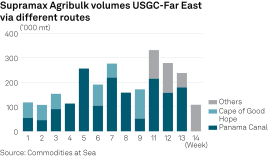
According to S&P Global Commodities at Sea, total metric tons of agribulk cargo on Supramax/Ultramax vessels transiting the Panama Canal have fluctuated since the start of 2026, and since week 11, vessels have increasingly chosen other routes.
A Germany-based dry bulk broker said, "Delays can remove effective tonnage from circulation, supporting freight rates."
A London-based dry charterer said: "The current auction price for a slot is around $700,000 to $800,000." The charterer added that "Containers, cruise ships and LNG carriers are at much higher demand and of higher value, hence it isn't worth it for a dry bulk carrier to pay such high prices." The same charterer said uncertainty around the disruption remains high. "It is entirely unclear why there is so much disruption. Some are seeing a 15-day waiting period, although certain carriers are getting better access to booked slots, specifically those who use the Canal the most."
The charterer said other transiting options, like the Strait of Magellan, were being considered due to possible higher bunkering costs in Durban, transiting via the Cape of Good Hope.
Another Dubai-based Supramax shipbroker heard of "one cargo in the East Coast of South America/ West Coast Central America that's been up for almost 2 weeks. Cape Horn would be too long a route, and bulkers are avoiding the Panama Canal. Charterers are asking for 2-3 laden legs now instead of a time charter trip."
Platts last assessed the 50,000 metric tons New Orleans-Kashima fronthaul grains route at $51.25/mt, up $3.25 from Feb. 27, but down $6.50 from its Q1 peak on March 12.
The port agent said most operators expect elevated congestion to persist into late Q2, driven by sustained LNG flows toward Asia, prioritization of higher-value and auctioned transits, and ongoing operational caution around water levels, even when conditions improve marginally. A meaningful easing would likely require either a seasonal drop in LNG eastbound demand or a formal increase in daily transit slots, which has not yet been communicated.
