LNG, Natural Gas
April 08, 2026
INTERVIEW: Atlantic SEE seeks final European gas deals by summer

By Matt Hoisch
Editor:
HIGHLIGHTS
Eyeing Alexandroupolis for another Greek FSRU by 2030: CEO
Signing 4 Bcm/year agreements will allow infrastructure investment
Exploring added US LNG supplies amid Iran war
Atlantic SEE LNG Trade expects to finalize several LNG offtake agreements with buyers across eastern Europe in the coming months that will position it to advance plans to develop another LNG import facility in Greece by the end of the decade, the nascent company's CEO told Platts, part of S&P Global Energy, in a recent interview.
"By the beginning of summer, I think we will be all there for the initial quantity we had in mind -- about 5 Bcm/year," Alexandros Exarchou said April 7.
Exarchou is also chairman and CEO of Greek infrastructure company AKTOR Group, which holds a 60% stake in Atlantic SEE. Greek gas and LNG importer DEPA owns the remaining 40% stake.
The company, formed in late 2025, signed a 20-year LNG sales and purchase agreement in November with Venture Global, which allows Atlantic SEE to purchase LNG equal to up to 4 Bcm/year of gas from the major US exporter from 2030, according to Exarchou. Venture Global did not respond to a request for comment.
Atlantic SEE has since signed several memorandums of understanding to supply LNG to buyers in countries around Europe's so-called Vertical Gas Corridor, including Romania, Bulgaria, Ukraine, Albania, and Bosnia and Herzegovina.
Exarchou said on April 7 that the company expects to sign another MOU in April, without providing further details.
Atlantic SEE anticipates finalizing the Albania, Bosnia and Herzegovina, and Romania deals first, according to Exarchou.
The Bosnia agreement faces legal uncertainty. The Bosnian government has objected to the MOU signed with aluminum producer Aluminij Industries and its owner, MT Abraham Group, saying only the Bosnian company Energoinvest is authorized to import gas into the country.
Exarchou said the legal question was not a concern for Atlantic SEE.
"The problem, I think, is not ours," he said. "It is the problem of the offtaker to deal with the government of Bosnia."
MT Abraham Group did not reply to a request for comment.
New FSRU plans
On top of selling its LNG, Atlantic SEE also has to develop infrastructure "critical" to facilitate deliveries, Exarchou said. While the company hopes to lock in further supply deals to sell as much as 10 Bcm/year, according to Exarchou, securing offtake for its 4 Bcm/year from Venture Global would suffice to advance that infrastructure work.
"If we manage to have the offtakes of the Venture Global agreement, that's enough for us to proceed with investing," he said.
The company wants to expand Greece's LNG import capacity by developing another floating storage and regasification unit. It hopes to have a 4.5 Bcm-5 Bcm/year FSRU in place around late 2028 or early 2029 and "no later than" the start of 2030, according to Exarchou.
While it has yet to finalize a location, Exarchou said Atlantic SEE is discussing two spots and is currently "focusing" on Alexandroupolis, which is already home to Greece's only existing FSRU. The second of Greece's two current LNG import terminals is the onshore Revithoussa facility.
Atlantic SEE plans to begin work to order the FSRU in autumn 2026 and has already started permitting discussions with the government, according to Exarchou.
The infrastructure work would also involve modifying existing pipelines to boost south-north gas flow capacity, he said.
Iran war reaction
While Atlantic SEE is advancing long-term plans stretching to the middle of the century, it is also adapting over the shorter term to the Iran war that has rocked global energy markets.
"Initially, we were looking simply to start serious operations in 2030," Exarchou said. "What has happened in the Middle East has actually attracted our attention to secure quantities earlier than that."
That is because Exarchou sees the hit to Qatari LNG exports from the war deepening Europe's reliance on US cargoes, regardless of when the fighting ends.
"The market for US LNG in Europe will go crazy, I expect, this winter and of course next winter as well," he said.
As such, Atlantic SEE is seeking to leverage its existing long-term US LNG offtake position to "maximize" its ability to secure shipments in 2027 and 2028, Exarchou said. However, he said he remains unsure whether the US has enough LNG available to guarantee meeting Europe's elevated requirements.
"There are not adequate quantities or a lot of quantities available in the US currently in order for them to commit," he said. "These two years [2027 and 2028], Europe will need as much US LNG as possible."
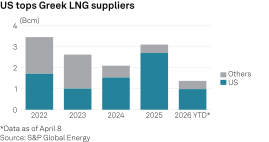
Exarchou remains undeterred by simmering transatlantic tensions that have strained EU-US relations in recent months.
While he said he has not spoken with Trump administration officials about the US government's commitment to maintaining LNG exports, he is "certain" US producers will fulfil supply agreements.
At the same time, Atlantic SEE is also exploring other supply sources closer to the company's targeted buyers to bolster its portfolio.
"We are already looking at some smaller -- but not insignificant -- supplies of European gas," Exarchou said.
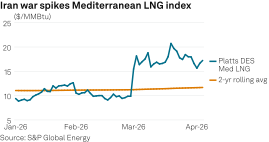
European LNG prices have soared since the outbreak of the Iran war. Platts assessed the DES Mediterranean LNG marker at $17.228/million British thermal units on April 7, up 3.6% from April 2. The index is 74% higher than in late February, when the war began.