LNG, Maritime & Shipping
March 25, 2026
LNG retains bunker fuel edge in Europe despite war-driven volatility

By Megan Gildea
Editor:
HIGHLIGHTS
Rotterdam LNG premium to VLSFO narrower than pre-conflict
LNG bunker discount to MGO widens to record $10/Gj
Structural factors support LNG's competitiveness
LNG bunker fuel has remained competitively priced against conventional marine fuels despite heightened volatility across global energy markets triggered by the Iran war, with spreads to both very low sulfur fuel oil (VLSFO) and marine gasoil (MGO) underscoring its relative resilience.
The escalation of conflict in the Middle East in late February injected significant bullishness into commodity markets, with LNG prices rallying sharply in early March amid supply disruption concerns and broader geopolitical risk. However, oil markets also surged, tightening LNG's relative position in the marine fuel mix.
In particular, LNG markets reacted to severe supply concerns; QatarEnergy, the world's second-largest LNG exporter, on March 4 declared force majeure on its LNG supplies to affected buyers, having earlier halted LNG production on March 2 amid the ongoing war in the Middle East.
LNG bunker fuel stood at a premium of 68.2 cents/Gj to VLSFO on March 24, according to Platts data, maintaining its position above the fuel oil benchmark.
But it remains narrower than levels prior to the conflict. Between Jan. 1 and Feb. 27, LNG averaged a premium of $2.25/Gj to VLSFO, highlighting a notable improvement in competitiveness despite recent volatility, which notably saw LNG jump from a 46.6 cent/GJ premium to a $2.658/Gj premium to VLSFO on March 2.
The spread dynamics briefly shifted back in LNG's favor in early March. On March 9, LNG flipped to a discount of 5.2 cents/Gj against VLSFO -- the first time it had undercut the oil-based fuel since the end of summer 2025. The inversion was driven primarily by a stronger rally in oil markets relative to LNG, as crude and refined products reacted more acutely to geopolitical risk.
Although LNG has since returned to a premium against VLSFO, the overall structure points to a more competitive landscape compared with pre-war conditions.
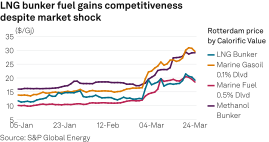
Against marine gasoil, LNG's advantage has strengthened more decisively. The discount to MGO widened to over $10/Gj -- the largest since Platts began its LNG bunker fuel assessments on Sept. 27, 2021. This compares with a much narrower discount of $3.978/Gj on Feb. 27, immediately before the onset of the conflict.
The widening spread reflects both the relative strength in fuel oils and LNG's comparatively moderate gains, even amid a broader rally in gas markets.
Market participants noted that LNG's ability to retain -- and in some cases improve -- its competitiveness during a period of geopolitical stress marks a departure from previous crises, such as the aftermath of Russia's invasion of Ukraine, when gas markets experienced more extreme dislocations.
The premium of LNG bunker fuel in Rotterdam surged to a high of $71.989/Gj on Aug. 26, 2022, while the premium to MGO reached $63.362/Gj on the same day, according to Platts data.
Traders cite the build-out of regasification capacity in Europe as well as relatively low demand in Europe and Asia, providing a buffer to LNG cargo spot prices, despite the high current price environment.
Europe hit 261.27 million mt/year of regasification in 2025, up from 201.82 million mt/year in 2022, according to S&P Global Energy CERA data. It projects it will rise further to 269.76 million mt/year this year.
Structural factors are also reinforcing LNG's position in the bunker fuel mix. The continued rollout of LNG dual-fueled vessels in 2026 is expected to underpin demand, while shipowners remain sensitive to fuel spread economics when making operational decisions.
Global LNG bunkering vessel capacity is projected to double by 2028, reflecting growing confidence in LNG as a marine fuel.
Despite ongoing volatility and uncertainty tied to the US-Iran conflict, current price relationships suggest LNG remains a viable and increasingly competitive alternative to conventional marine fuels in key bunkering hubs.
