Chemicals
May 14, 2026
India's eMethanol push for shipping hobbled by bio CO2 crunch, price gap
By Vipul Garg and Chris To
Editor:
HIGHLIGHTS
eMethanol project developers quote $725-$1,250/mt FOB India
Buyers seek about $550/mt on shorter contracts
CO2 logistics and port proximity raise project costs
Limited access to reliable CO2 from biological or renewable sources is undermining Indian eMethanol projects aimed at supplying bunker fuel and supporting shipping decarbonization, as producer prices remain substantially above buyer expectations.
At least eight Indian eMethanol projects surveyed by Platts, part of S&P Global Energy, cited sustained biomass availability as their biggest challenge, with several developers stating that the scarcity of biogenic CO2 sources at the required scale has resulted in higher eMethanol offers.
Market sources said Indian eMethanol export-oriented projects face infrastructure constraints that mirror broader challenges across the global renewable fuels sector. Securing biogenic CO2 adds complexity. Developers say eMethanol plants must be near both CO2 sources and ports -- a difficult and costly combination.
"Your methanol plant needs to be very close to a biogenic CO2 source, and the plant also needs to be close to a port. That combination is tricky; otherwise, it gets expensive," an eMethanol project developer said.
The challenges have complicated efforts to meet expected marine fuel demand, with eMethanol developers quoting $725-$1,250/metric ton FOB India for EU renewable fuels of non-biological origin-compliant contracts spanning 10-15 years and covering volumes of 100,000-300,000 mt/y, while prospective buyers are seeking prices closer to $550/mt for shorter three-year deals.
"We doubt anybody would be able to offer eMethanol at less than $1,100/mt," another project developer said, adding that even 10-year contracts pose bankability challenges, as shipping companies prefer shorter tenures. "The problem is that biomass is spread out, and we would need to aggregate the volumes from various places, and that too for the long term."
The concerns underscore a critical infrastructure gap as the maritime industry races to meet emissions targets, with shipping companies requiring alternative fuels that can be deployed across global routes, including EU waters, where stricter regulations apply.
Market sources said developers must balance regulatory requirements, technical complexity and commercial viability while building entirely new supply chains for eMethanol. The outcome will help determine whether eMethanol can emerge as a viable shipping fuel or whether the sector will pivot to alternative solutions, such as renewable ammonia.
Pricing gap
The wide buy-sell spread has highlighted varying assumptions regarding contract duration, production scale, and CO2 sourcing strategies.
The first developer quoted $950-$1,080/mt, depending on a contract length of 10 to 15 years. A third eMethanol project developer proposed $900-$1,000/mt, emphasizing that a minimum production of 100,000 mt/y is required to achieve competitive prices.
A fourth eMethanol project developer estimated that initial offers would be around $1,100/mt FOB India for 100,000-150,000 mt/y over 10 years, but prices could fall to $725-$760/mt, referencing competitive bidding observed in Indian ammonia tenders.
The quotes stand in stark contrast to the expectations of shipping companies, which prefer shorter tenures, and are notably higher than the prices of some alternative fuels assessed by Platts.
Platts assessed Shanghai low-carbon methanol marine fuel delivered Shanghai at $998/mt on May 13. The same product delivered Singapore was assessed at $1,058/mt that day.
Platts assessed bunker LNG delivered Singapore at $1,009/mt on May 13.
Developers continue to pursue eMethanol despite challenges in establishing early relationships with shipping companies, hoping to secure future sales.
"A shorter tenure of three years is not doable now, but of course, when [shipping companies] have the ships ready, they would also want long-term supply from multiple sources," the third developer said.
The fourth developer said, "We expect demand in shipping for eMethanol would emerge sooner than for ammonia. Therefore, we are closely monitoring this opportunity to gain an early mover advantage."
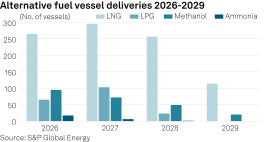
The Platts global bunker fuel cost calculator shows how Platts price assessments for methanol, ammonia, LNG, bioblends and conventional oil-based fuels can be used to calculate the cost of marine fuels around the world, taking into account the EU Emissions Trading System and adjusting for energy density to put them on an equal footing.
Biogenic CO2 challenges
Paper mills and biomass-fired plants have been identified as biogenic CO2 sources; however, eMethanol developers note that few facilities operate at the scale necessary for commercial production.
Aggregating biomass from multiple locations to ensure a long-term supply introduces additional cost and complexity, as boilers must be engineered to accommodate varying fuel specifications and calorific values.
A fifth eMethanol project developer indicated plans to initially blend biogenic CO2 with industrial CO2, gradually increasing the biogenic proportion as supply becomes more reliable.
However, this strategy may encounter regulatory challenges, since current RFNBO regulations permit CO2 capture from flue gas only until 2040, according to a sixth eMethanol project developer.
Biogenic CO2 is a key contributor to potential biomass-based fuel production pathways, such as green methanol, bio-LNG and e-LNG, anchoring the fuel to significant greenhouse gas savings in combination with renewable hydrogen.
The technical challenges have led some developers to reevaluate their strategies.
"An eMethanol plant is way more challenging than ammonia, so we would probably drop the plans and stick to ammonia because for ammonia, you simply take the nitrogen from air, but procuring biogenic CO2 is not so simple," the second developer said.
