Electric Power, Energy Transition, Renewables
May 11, 2026
Brazil renewable energy investments stall on curtailment woes

Editor:
HIGHLIGHTS
Curtailments hit 17.8% of wind and solar output
Companies halt investments amid compensation gaps
I-REC price gap sustained between hydro and wind/solar
Energy companies have been re-evaluating investments in the Brazilian renewable energy power sector due to uncertainty regarding curtailments in 2026, which have been accelerating in May and April.
After reaching record highs in 2025, curtailments of wind and solar energy have remained persistently close to 20% of potential generation in the first four months of 2026. Moreover, it is uncertain to what extent generators will be compensated for their losses.
"Companies are saying that they will no longer invest in Brazil until this situation is solved," Francisco Silva, director of regulatory matters at the country's wind power association, ABEEólica, told Platts.
Data shows curtailments have been accelerating in April and May as curtailments on Brazilian wind and solar power generation have reached an average 3 GW in 2026, until May 10, or 17.8% of the total potential generation from these sources, according to the National System Operator, or ONS. In 2025, they reached a record high of 20.7%, or 4.25 average GW.
In 2026, curtailments reached 16.5% of total wind generation and 20.6% of solar generation, according to the ONS.
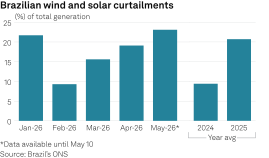
"Curtailments have not significantly increased in volume this year, compared with last year, but since we have a bigger pool of generators this year, their effects are felt more intensely," Silva said.
ONS expects curtailments to remain intense over the next few years, estimating an average 3.11 GW in 2026, before growing to 3.5 GW in 2027 and reaching an average of 3.65 GW in 2029.
"The main problem is not the curtailments per se, but the absence of any refund to generators, who are not responsible for these interruptions," according to Rodrigo Sauaia, executive president of the Brazilian solar photovoltaic association, ABSolar.
Investment halt
Some energy companies have begun re-evaluating projects as generation restrictions have reduced their financial returns.
In 2025, the Brazilian electric energy regulator, Aneel, withdrew 509 authorizations for wind and solar projects following requests by the companies, who had determined the projects were no longer viable. If completed, the projects would have added a combined capacity of 22 GW.
"Development of new projects tends to be paralyzed until a definitive solution for the curtailments is achieved, giving predictability and security," Sauaia said.
The supply of International Renewable Energy Certificates is also negatively affected by the curtailments.
Some generators, having committed to supplying vintage 2025 I-RECs, did not have sufficient generation to issue all the certificates from the certified plants. As a solution, companies had to register additional generation plants to issue the expected amount of I-RECs.
The operation creates unexpected costs to suppliers, who are more cautious in offering vintage 2026, fearful that curtailments could reduce generation and thus the availability of certificates.
So far, the impact on prices has been limited, as few clients are seeking 2026 I-RECs.
The assessments of Brazilian wind and solar I-RECs, vintage 2026, were Real 1.15/MWh (23 cents/MWh) May 8, while hydro was Real 0.96/MWh (19 cents/MWh) on the same date, highlighting a spread between the technologies.
Distributed generation
The expansion of distributed generation in Brazil, driven by households installing solar panels to secure a cheaper, more reliable energy supply, also challenges planners and policymakers.
Installed capacity of distributed generation, most of it solar photovoltaic, reached 48 GW in 2026, according to the national energy regulator, Aneel. In May 2025, the capacity was 40.5 GW; in January 2024, it was 26.6 GW.
This source exacerbates oversupply precisely during peak generation periods for solar and wind plants.
"Brazil is facing an excess of supply, mainly from 8 am until 5 or 6 pm. But after this period, the opposite happens, a lack of supply of electricity," Silva said.
But according to ABSolar, the benefits of growing distributed generation outweigh the costs. "The real problem is not too much distributed generation, but lack of flexibility, of transmission network, of storage solutions and transparency," Sauaia said.
A law approved in 2025 allows generators to be reimbursed for past curtailments, but its implementation is still under discussion. The energy ministry launched a public consultation, but generators claim they are being required to drop any ongoing legal actions on the matter in order to obtain compensation.
A long term solution will require further negotiations with generators, investments in batteries and storage and expansion of datacenters, according to these associations.
Platts is a part of S&P Global Energy.
