Energy Transition, Fertilizers, Chemicals, Hydrogen, Renewables
April 20, 2026
India may delay renewable hydrogen tenders until existing projects progress: official

By Vipul Garg
Editor:
HIGHLIGHTS
Awarded projects must be commissioned in three years
No changes to existing subsidy structure: official
Developers cite grid delays as timeline risk
Indian refineries and fertilizer companies may delay issuing new tenders for renewable, or "green," hydrogen and ammonia until existing awarded projects show progress, as concerns grow over execution, a senior official at the Ministry of New and Renewable Energy told Platts.
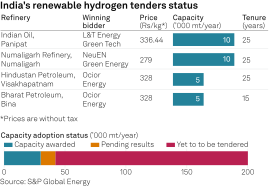
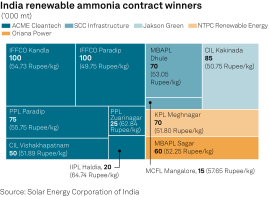
Following the government's push to boost domestic demand under the National Green Hydrogen Mission, six hydrogen developers have signed renewable ammonia agreements with 11 fertilizer companies, while four refineries have entered into renewable hydrogen deals with three developers.
Renewable ammonia contract winners have three years from the date of signing the agreements in March to commission their projects. Similarly, refinery tenders are also required to bring projects online within the next two to three years, depending on the tender conditions.
"Fertilizers are waiting for some visibility on the current awarded projects. If they start to see progress there and prices come down, they might come out with more volumes," the official said April 15, adding that refineries could issue additional tenders once the pending ones are concluded.
Four refineries have awarded contracts for a total of 30,000 metric tons/year of renewable hydrogen at a weighted average price of Rupees 314.5/kg ($3.39/kg). The Chennai Petroleum Corp. Ltd. tender attracted more than 10 bids last year, but the results have yet to be announced. On the other hand, a total of 670,000 mt/y of renewable ammonia deals were signed at a weighted average price of Rupees 53.35/kg.
The MNRE did not respond to a request for official comment from Platts on April 17.
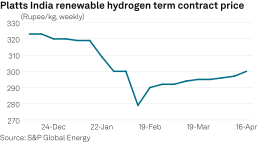
Platts, part of S&P Global Energy, last assessed the Indian renewable hydrogen term contract at Rupees 300/kg on April 16, more than 7% higher than the last-concluded Numaligarh Refinery Ltd. tender at Rupees 279/kg, driven by higher price offers reported.
Concerns over project execution
Project developers have raised concerns about competitive bidding and winners' willingness to forgo returns to secure contracts, casting doubt on project execution given the tight pricing and timelines.
"It would be reasonable if one or two projects fail, but if all of these projects are not able to progress or deliver, then it will be a big concern and might have to be rethought," the official said, referring to concerns over project delivery due to the aggressive pricing in this nascent market.
The official said India has no plans to modify its existing subsidy structure or 2030 production targets for at least three years, maintaining the current incentive framework under the Strategic Interventions for Green Hydrogen Transition program.
The official added that the government may introduce new subsidy schemes similar to the Bring Your Own Buyer initiative, which gives developers preference for incentives if they have offtake agreements in place.
"We are not changing targets and subsidies as of now. Maybe after three years we will have different thinking," the official said.
India offers production-linked incentives of up to Rupees 50/kg for renewable hydrogen under the Strategic Interventions for Green Hydrogen Transition program, aimed at bridging the cost gap between conventional and renewable hydrogen. The subsidies are available for three years from the commencement of commercial production.
India's green hydrogen strategy targets production of 5 million mt/y by 2030, primarily for use in refineries and fertilizer plants, while also positioning the country as a potential exporter.
Govt support needed for timely execution
Winning bidders have suggested that the government address potential delays arising from regulatory and compliance hurdles, such as grid connectivity, land allocation and related issues, to ensure projects are commissioned on time.
"We can identify the land, but the allocation and regulatory and compliance approvals are in the government's hands," a renewable ammonia contract awardee said.
The awardee added that arranging water and setting up transmission networks are among the issues that can delay plant commissioning, saying, "We need proper support from the government."
"Connectivity is a challenge because there is a minimum one-year delay in getting grid connectivity through CTU [Central Transmission Utility] or STU [State Transmission Utility]," another awardee said, adding that they have already applied for connectivity and are waiting for action from the government.
The official said they are working on the connectivity challenge to ensure projects meet their commissioning timelines.
