Energy Transition, Carbon
April 15, 2026
Surrenders rise 58% in Australia’s Safeguard Mechanism for 2024-25, SMC use up

Editor:
HIGHLIGHTS
Total credit surrenders at 13.4 million units
SMC surrender rate doubles to 38.8% in 2024-25
ACCUs dominate compliance at 80.6% of credits
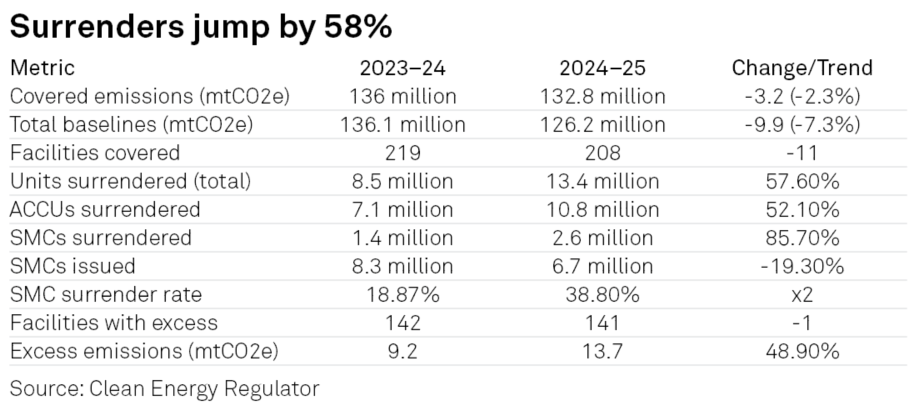
Australia's Safeguard Mechanism saw a sharp increase in credit surrenders for the 2024-25 compliance period, with total units surrendered rising 57.6% year over year to 13.4 million, according to Clean Energy Regulator data released April 15.
The increase was driven by higher use of Australian Carbon Credit Units and Safeguard Mechanism Credits, as facilities adjusted to stricter baselines and a growing compliance burden.
The market reaction to the data remained soft, as the numbers were in line with the CER's earlier projections.
"It's about the same as preliminary data," a trader with a Safeguard entity said.
Another New Zealand-based trader dealing with ACCUs echoed the sentiment and said that there's nothing exciting about the data, so there's no immediate market reaction.
"Usually, there's always a reaction. Good or bad, but there is something. Surprisingly, today I haven't heard any trade. Shocking, but must be because every number seems same," the trader said.
While ACCUs are issued to incentivize carbon abatement activities and can be traded between any parties, SMCs incentivize emitters to reduce emissions below baseline levels.
Platts, part of S&P Global Energy, assessed benchmark Generic ACCUs at A$36.50/mtCO2e on April 15, steady day over day.
SMCs surrender rate doubles, but ACCUs still dominate
The 2024–25 period saw a significant rise in SMC use. CER reported about 6.7 million units issued in FY2024–25, in line with S&P Global Energy Horizons' Australian Carbon Market Outlook 2026 report estimate of 6.6 million, suggesting a near-term compliance picture unfolding as expected.
During the period, out of the 6.7 million SMCs issued, 2.6 million were surrendered. The surrender rate is 38.8%, more than double the 18.87% rate in 2023–24.
"Through to 2030, SMCs are likely to account for only part of the compliance mix, and continued reliance on ACCUs should be understood as a natural feature of the market's design," Abhijeet Thakkar, Senior Principal Analyst, Compliance Carbon Markets at S&P Global Energy Horizons, said.
Thakkar said that cumulative SMC issuance from FY2025-26 to FY2029-30 could reach about 31 million units, compared with total credit requirements of about 105.5 million units, leaving ACCUs to play a central balancing role.
The degree of reliance will nonetheless vary by facility, depending on the available abatement options and the cost of pursuing internal emissions reductions.
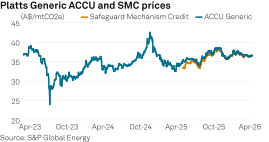
However, ACCUs remains the dominant compliance instrument, accounting for 80.6% of all credits surrendered, 10.8 million out of 13.4 million.
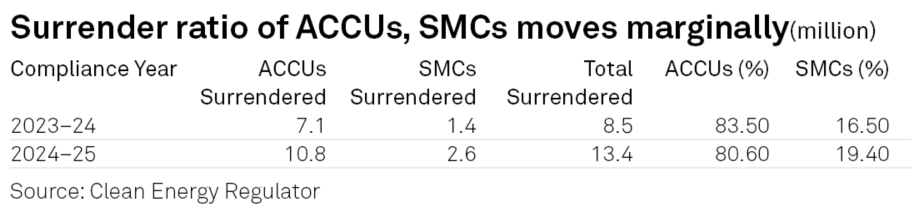
Platts assessed SMCs at A$36.50/mtCO2e, April 15, steady day over day, at parity with Generic ACCUs.
A second trader from the Safeguard entity said that the total proportion of SMCs and ACCUs used remains almost unchanged, indicating that a significant volume is available in the market.
"With more SMCs issued each year, we will surely see an increase in the trading activity and surrenders, but I feel the portion will remain low," the New Zealand-based trader said.
"No surprise. Hard to say [how the market will react and where it will move]. I think they may want to balance their cost. But avoid using too many SMC. Some companies see SMC not in line with their ESG policy," an Asia-based trader dealing in ACCUs said.
At the same time, SMC issuance fell 19.3% year over year, from 8.3 million to 6.7 million, reflecting the impact of declining baselines and tighter compliance requirements. A total of 54 facilities received SMCs in 2024-25, down from 62 the previous year, reflecting a tighter allocation as the scheme matures.
Entities covered fall; liability up
The Safeguard Mechanism applies to Australia's largest greenhouse gas-emitting facilities—those emitting more than 100,000 mtCO2e per year—requiring them to keep emissions below declining baselines or offset any excess emissions by surrendering ACCUs or SMCs. For 2024–25, 208 facilities were covered, down from 219 the previous year.
Covered emissions fell 2.3% to 132.8 million mtCO2e, while total baselines dropped 7.3% to 126.2 million mtCO2e, marking the first time covered emissions exceeded total baselines. The number of facilities with excess emissions remained steady at 141, but the total excess rose sharply to 13.7 million mtCO2e, up 48.9% year over year.
