Energy Transition, Emissions, Carbon
April 14, 2026
CDR buying not ended; removals 'one piece' of decarbonization: Microsoft
Editor:
HIGHLIGHTS
Decarbonization plan mix of reductions, efficiency, CDR: Microsoft
Move reflects disciplined approach, not reduced ambition: Nakagawa
Stakeholders view shift as recalibration, not exit
Microsoft has clarified that it has not ended its carbon removal program, but has instead adjusted the pace of its procurement as part of a 'disciplined approach,' the company's Chief Sustainability Officer Melanie Nakagawa told exclusively to Platts, part of S&P Global Energy, in an email April 14.
The company said its decarbonization strategy continues to combine emissions reduction, carbon removal and efficiency measures, and that adjustments to one element do not signal a broader pullback.
"Carbon removal is one piece of that equation," Nakagawa said. "We continue to both build on and support our existing portfolio of both nature-based and technology-based solutions."
Several media outlets reported over the weekend that Microsoft was pausing its CDR buying program, denting market sentiment on April 13 amid concerns among stakeholders that demand from major corporate buyers could weaken.
A number of early-stage carbon removal projects are heavily reliant on long-term offtake commitments from large technology firms.
Microsoft has committed to becoming carbon negative by 2030 and has entered into purchase agreements covering more than 60 carbon removal projects. However, the company's greenhouse gas emissions have risen in recent years, driven largely by the rapid expansion of energy-intensive data center infrastructure.
Platts reported April 13 that market participants view the pause as a recalibration rather than an exit, with Microsoft likely taking stock of delivery timelines and performance across its existing portfolio.
"At times we may adjust the pace or volume of our carbon removal procurement as we continue to refine our approach toward our sustainability goals," Nakagawa said. "Any adjustments we make are part of our disciplined approach- not a change in ambition."
Market reaction
Stakeholders and experts in the carbon market said that near-term uncertainty among corporate buyers is compounding funding pressure in the sector, as major technology firms increasingly prioritize generative artificial intelligence and other growth investments, often at the expense of sustainability budgets.
"In terms of signed deals, anything that was already well-advanced or contracted has largely continued to close, albeit in some cases with slightly extended timelines as counterparties reassess," Dr. Renard Siew, head of corporate sustainability at Yinson Holdings Berhad, told Platts. "We're not seeing widespread retrading, which suggests confidence in existing commitments remains intact."
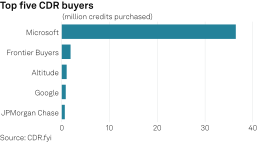
Microsoft remains the world's largest purchaser of CDR credits, according to data from CDR.fyi, having contracted more than 36.4 million metric tons of removals to date. This far exceeds the second-largest buyer, the Frontier buyer coalition, which has purchased about 1.8 million mt.
The tech giant Microsoft accounted for just over 41% of forward purchases of voluntary carbon credits between 2023 and 2025, according to S&P Global Energy Horizons data.
Microsoft's potential pause in carbon removal purchasing reflects a maturing market rather than a fundamental threat to the industry's growth trajectory, according to the Carbon Business Council, which said the tech giant's early investments helped lay the foundation for broader market participation.
The company's role in demonstrating a science-based approach to building diversified carbon removal portfolios created critical early demand signals that helped nascent technologies and nature-based solutions gain commercial traction, Ben Rubin, executive director of the Carbon Business Council, said. That foundation has allowed the carbon removal market to evolve beyond dependence on a handful of large corporate buyers, he said.
"Microsoft has been foundational in scaling the carbon removal industry, both by demonstrating a thoughtful, science-based approach to building a diversified portfolio of solutions and by creating the early demand signals needed to help these solutions grow," Rubin said. "No forward action will erase that impact."
It was only on April 6 that Microsoft signed a deal with carbon management company Svante and the Meadow Lake Tribal Council in Saskatchewan to capture 626,000 metric tons of CO2 from biomass-fired power generation.
Carbon removal refers to climate mitigation strategies that remove CO2 emissions from the atmosphere, as opposed to strategies to avoid such emissions. These encompass a wide array of approaches, including technology-based methods like direct air capture, biomass carbon removal and storage, and also nature-based projects such as afforestation and reforestation.
The Platts Natural Carbon Capture price was assessed at $13.95/mtCO2e April 13, while Platts Biochar for US projects was priced at $155/mtCO2e on the same day. Platts is part of S&P Global Energy. This premium on tech-based credits reflects a much higher cost of implementing projects, but also a perception of lower risks linked to issues such as environmental integrity, additionality and permanence.
