Energy Transition, Carbon
April 13, 2026
EC plans to consult states 'shortly' on updated EU ETS benchmarks

Editor:
HIGHLIGHTS
To use 'all flexibilities' in legal text: von der Leyen
Full ETS review remains scheduled for July
EU carbon prices trade near Eur72/mtCO2e
The European Commission will consult member states "shortly" on updated benchmarks for free carbon permit allocations under the EU Emissions Trading System, EC President Ursula von der Leyen said April 13, as industries anxiously await clarity on how many free allowances they will receive through 2030.
The announcement, made during a speech on the impact of the Middle East conflict on the EU, signaled that the commission would use some flexibilities when revising the sectoral benchmarks that determine free EU Allowance allocations to industrial facilities based on their emissions intensity.
"We will shortly consult member states on updated ETS benchmarks using all the flexibilities the legal text gives us," von der Leyen said. "And as announced, we are on track to present the full review of the ETS system in July."
The timing of the benchmark update has become a focal point for European industry as companies face mounting pressure from high energy costs, international competition and the phaseout of free allocations for sectors covered by the EU's Carbon Border Adjustment Mechanism.
The commission was expected to adopt implementing regulations for updating ETS benchmark values by the end of the first quarter, but this process has been delayed by a few weeks.
These sectoral benchmarks determine the share of free EU ETS permits allocated to industrial facilities based on their emissions intensity relative to the most efficient producers. Free allocations are based on benchmarks derived from the average greenhouse gas emissions of the 10% most efficient installations covered by the EU ETS for that product.
The commission's reassessment comes amid growing calls from industry for extensions to free allocation rules, which currently require a complete phaseout by 2034 for CBAM-covered sectors, including steel, cement, aluminum and fertilizers. Companies have said the combination of carbon costs and international competition threatens European industrial competitiveness.
ETS reforms
Von der Leyen's comments on benchmarks came as part of broader remarks on measures to address the EU ETS costs, which have come under relentless pressure from EU leaders and industry in 2026.
The commission has already proposed changes to the Market Stability Reserve, which involve ending the practice of invalidating all carbon allowances above 400 million in the MSR.
"Thus, we are enhancing the stability and predictability of ETS prices without losing the important price signal," von der Leyen said, referring to the MSR reforms announced.
The MSR reduces the supply of allowances when there are too many in circulation and injects allowances when there is scarcity.
EU carbon prices have declined steadily in recent months as the commission signals potential reforms to free allocation rules and allowance supply caps. The market has been closely watching for signals on how Brussels will balance industrial competitiveness concerns with the bloc's climate ambitions.
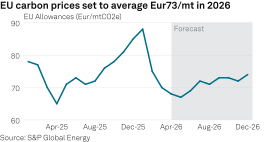
EU carbon prices have slumped by almost Eur30/metric ton of CO2 equivalent in 2026 after several member states called for watering down the EU ETS to boost the bloc's industrial competitiveness.
Platts, part of S&P Global Energy, assessed EU Allowances for December 2026 at Eur72.55/mtCO2e on April 13. EUAs surged to 30-month highs of Eur92.09/mtCO2e on Jan. 15, according to Platts data, before plunging by almost Eur30/mtCO2e to lows around Eur62/mtCO2e by mid-March.
The full review of the EU ETS system remained on track for presentation in July, von der Leyen said. The comprehensive revision is expected to address various aspects of the system, including long-term free allocation rules, the role of CO2 removals and adjustments to the cap trajectory as the bloc works toward its 2040 climate targets.
