Energy Transition, Coal, Carbon, Emissions
April 10, 2026
European carbon prices hover near Eur73/mt as policy jitters ease

Editor:
HIGHLIGHTS
Fundamentals could start to drive prices
Market Stability Reserve reform eases some policy uncertainty
European carbon prices increased slightly in the week ended April 10, following news of a ceasefire in the Middle East. However, prices also came under brief pressure from provisional estimates showing only a slight decline in total CO2 emissions under the EU Emissions Trading System in 2025.
EU Allowances were trading at Eur72.85/metric ton of CO2 equivalent ($85.46/mtCO2e) at 1408 GMT on April 10, according to the Intercontinental Exchange, up 1.5% from the April 2 settlement. Platts, part of S&P Global Energy, assessed EU Allowances for the December 2026 contract at Eur73.67/mtCO2e on April 9.
Jitters about ETS policy have eased after the European Commission proposed halting the automatic invalidation of carbon allowances held in the Market Stability Reserve, which helped drive EUA prices higher.
The proposed amendment would end the current practice of invalidating all carbon allowances above 400 million in the Market Stability Reserve, instead preserving them as a buffer to support market stability.
The Market Stability Reserve reduces the supply of allowances when there are too many in circulation and injects allowances when there is scarcity.
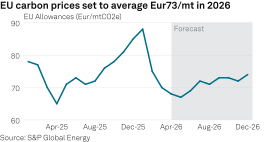
Fundamentals vs policy
Fundamentals are expected to play a bigger role in price direction than policy.
EUAs have largely shrugged off Middle East tensions, proving more resilient than other commodities. EUAs fell slightly before US President Donald Trump's Iran deadline April 7 but staged a muted rally after the ceasefire on April 8.
Instead, EUA prices have tracked broader economic confidence indicators and market reform expectations, with power sector demand playing a secondary role.
Analysts at S&P Global Energy Horizons expect EUAs to average Eur68/mtCO2e and Eur72/mtCO2e in the second and third quarters, respectively.
"EUA prices in 2026 are likely to trade in a range-bound but slightly weaker regime, with downside limited by cautious reform and continued structural tightness, but upside constrained by regulatory uncertainty and intervention risk," the analysts wrote in a recent note.
Regulated CO2 emissions from power plants and factories in 2025 fell by about 1.5% from the previous year, according to calculations from several analysts. The European Commission is expected to officially release the verified EU ETS emissions data later on April 10.
The EU ETS is facing mixed fundamentals, spurred by the war, with improving coal consumption offering support on the one hand and declining industry demand from the petrochemicals and refining sectors weighing on the other.
While EUA prices have diverged considerably from natural gas over the past month, coal economics have provided limited support for carbon, as coal becomes more lucrative in the power generation mix due to high gas prices.
