Energy Transition, Carbon, Emissions
April 08, 2026
Japan's GX-ETS mandatory phase begins; demand muted as companies await allocation clarity

Editor:
HIGHLIGHTS
J‑Credits, JCM unit demand to stay weak through FY 2026-27
Prices anchored around proposed GX‑ETS price ceiling
Ex-post allocation design clouds near-term compliance signals
One week after Japan's Green Transformation Emissions Trading Scheme (GX-ETS) entered its mandatory phase, trading activity in J-Credits and Joint Crediting Mechanism units remains absent -- particularly on the exchange -- as covered entities continue to delay compliance positioning amid ongoing uncertainty over free allowance allocations and banking rules.
Mandatory in name, transitional in practice
The GX‑ETS moved into Phase 2 on April 1, following a three‑year voluntary period, and now applies to companies emitting at least 100,000 metric tons/year of CO2, collectively accounting for roughly 60% of Japan's emissions.
The scheme allows covered entities to meet up to 10% of their compliance obligations with eligible credits -- including domestic J‑Credits and international JCM units -- within a price corridor set by the government at Yen 1,700-4,300/mtCO2e ($10.64-$26.91/mtCO2e).
However, several Tokyo‑based market participants said fiscal year 2026-27 (April-March) is unlikely to generate strong compliance‑driven credit demand, as the scheme's free allocation framework remains unsettled.
"At this moment, we have not seen any official updates on the finalization of free allowance volumes by industry," a Tokyo‑based end user said, adding that allowance clarity will only emerge after companies submit verified emissions data and receive government approval.
Prices hover near price ceiling
Despite limited liquidity one week into the mandatory phase, J‑Credit prices remain broadly supported by the GX‑ETS cost‑containment measure.
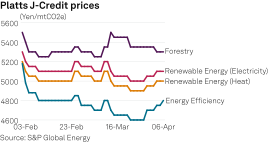
Platts, part of S&P Global Energy, assessed Energy Efficiency J-Credits at Yen 4,800/mtCO2e and J-Credit Forestry at Yen 5,300/mtCO2e on April 7, both unchanged day over day.
The government has proposed a price corridor of Yen 1,700-4,300/mtCO2e for the early compliance years, with entities able to meet their obligations by paying the ceiling price if allowance markets tighten.
Energy‑efficiency J‑Credits have recently traded at about Yen 4,800/mtCO2e, based on Japan Exchange Group reference prices, according to a Tokyo‑based end user. "From my perspective, prices remaining slightly above the GX‑ETS ceiling are so far a positive indication," the source said.
A second end user expects prices to remain largely rangebound in the absence of strong demand. "As there is no strong demand from GX‑ETS, we believe market prices of J‑Credits will theoretically dwindle," the source said, adding that most holders are likely to retain inventory unless liquidity needs arise.
Some premium demand persists for specific credit types -- particularly locally generated forestry J‑Credits -- but volumes remain too small to influence broader market dynamics.
"Some customers require specific credits, especially forestry credits, such as locally generated ones, and they would pay significantly higher prices than those in the market," the second end user said. "However, the impact on the market could be negligible because the volumes are tiny, and ultimately, there is no difference in value under the compliance regulations."
Conversely, a Tokyo-based carbon project developer said there is currently no premium for forestry J‑Credits, citing demand solely for compliance purposes and a large supply from major forest owners exceeding 100,000 mt/y.
Ex-post allocation clouds price signals
Market participants said uncertainty around banking provisions -- specifically whether unused allowances or credits can be carried forward -- has further dampened appetite for early compliance buying.
Unlike systems with fixed upfront caps, free allowances under the GX‑ETS are determined ex post, based on actual production levels and sectoral benchmarks.
"Under the GX‑ETS framework, free allowances are expected to be allocated after each regulated entity submits its calculated emissions and applies for allowances," the first end user said. "As a result, allowance volumes will only become visible once this application and approval process is complete."
A Tokyo-based consultant developer echoed this sentiment, saying that the number of free allocations will be determined based on each fiscal year's actual production levels, rather than in advance.
Companies will initially set emissions targets for FY 2025-26 and FY 2026-27. Actual FY 2025-26 emissions will be calculated and third‑party verified in early 2027, after which the government will issue official allocations for the following year based on benchmark indices.
"Because the final number depends on how much a company actually [emitted], the definitive number of free allowances for FY 2025-26 cannot be calculated until the fiscal year ends," the consultant said, adding that settlement will occur only in 2027.
The consultant expects incremental clarity from April onward as submissions begin but cautioned that any impact on demand is likely to emerge only gradually. "I anticipate that updates on both free allocation levels and banking rules will gradually become available during this period," the consultant said.
The consultant added that the GX‑ETS is not yet aligned with Japan's Nationally Determined Contribution and currently operates without a system‑wide cap, underscoring the importance of still-pending benchmark announcements in shaping compliance behavior.
Eyes on post-2027 signal
Participants broadly view FY 2026-27 as a calibration phase, with meaningful compliance demand expected to emerge only once benchmarks, free allocation levels and banking rules are fully clarified.
"I do not think any lobbying is feasible after the government's announcement," a Tokyo‑based end user said. "The next opportunity to negotiate floor or ceiling prices would be around 2029."
Until then, market participants said the GX‑ETS mandatory phase is likely to establish the institutional groundwork for Japan's carbon market rather than serve as a near‑term catalyst for J‑Credit or JCM unit demand.
