Energy Transition, Electric Power, Carbon, Emissions, Renewables
April 08, 2026
Brazil renewables market divided about GHG Protocol update
By Felipe Peroni and Beatriz Baltieri
Editor:
HIGHLIGHTS
GHG Protocol revision divides Brazil energy sector
Hourly matching rules threaten renewables growth
I-REC prices remain low amid oversupply concerns
Revising the global Greenhouse Gas protocol to require the matching of hourly energy consumption and generation has divided generators and consumers in Brazil, with some believing such a change could hamper the country's renewables market.
The proposed stricter rule is causing concern among those in the Brazilian energy sector who fear it could reduce adherence to emission standards and trading of guarantees of origin, which already face liquidity issues.
"Hourly matching requirements could hamper the maturity process of the Brazilian market," said Felipe Gatti, head of power at major beef exporter Minerva Foods. The company reports its emissions under the Brazilian GHG Protocol program.
If approved, a company now certifying energy consumed in an entire year would be required that all certificates be matched on an hourly basis, for its energy use to be considered renewable. Moreover, the recommendations made by the GHG Protocol working group also include stricter geographical rules of origin.
"The changes proposed also include the location method, that would prevent a company in the south of Brazil to buy International Renewable Energy Certificates registered in the country's northeastern region," Fernando Lopes, director of the Totum Institute, which issues the country's I-RECs and other guarantees of origin, said April 7 during the I-REC Day Brazil conference.
The GHG Protocol board held a public consultation about the scope 2 guidance change, from October 2025 to Jan. 31, 2026. According to Lopes, a second public consultation will be made in 2026. The revision was considered necessary as the current scope 2 guidance was released in 2015, and new criteria was needed to reflect the evolution of energy grids and companies. Also, the GHG Protocol estimates that 40% of global greenhouse gas emissions can be traced to energy generation, making it more critical to decarbonization.
But some market participants believed this change could reduce interest for certificates in a less evolved markets, such as in Brazil, where energy certification it is purely voluntary.
"As participants of a voluntary initiative, we need to find ways to contribute while remaining competitive with other non-adherent companies," Gatti said.
Significant generators were optimistic about the change, however, believing it could boost prices of I-RECs that meet the stricter requirements.
"In Brazil we face a persistent oversupply [of certificates]. This new layer of integrity could improve the price balance in the country," said Cecilia Essinger, executive manager of environmental assets at Axia Energia, adding that the change will also require a phasing period for adaptation.
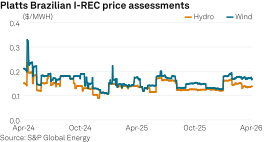
Platts' daily assessment of Brazilian I-RECs, vintage 2025, were at Real 0.87/MWh (17 cents/MWh) for wind and solar on April 8, and at Real 0.71/MWh (14 cents/MWh) for hydro. By comparison, the assessment for Mexico 2025 wind/solar I-RECs was at $6/MWh on the same day. Platts is a part of S&P Global Energy.
Axia received recently a request for 24-7 hourly matching certification, but shortcomings in the existent infrastructure blocked the way, according to Essinger. The company was the largest issuer of I-RECs in 2025 in Brazil, with 11.9 million certificates.
"I-RECs still need more differentiation to shows its environmental benefits, like the ones we see in carbon credits," Essinger said.
"This change will only benefit hydroelectric companies in the Brazilian southeastern region," a source at a wind power generator said.
A second generator source concurred.
"This could drive consumers away from the I-REC market," the source said.
