Energy Transition, Carbon, Emissions
March 20, 2026
Indian developers push CDM projects to plug supply gap in nature-based removals

Editor:
HIGHLIGHTS
CDM-based afforestation credits seen as interim supply
Developers weigh ratings for non-VM0047 projects
Buyers ask for latest VM0047 vintages
Indian developers have been seeking to bridge a supply gap in nature-based carbon removal credits by offering newly issued units from projects using older Clean Development Mechanism (CDM) methodologies since at least early March, multiple developers, trade sources, and other market participants told Platts, part of S&P Global Energy.
Nature-based removal credits are generated from projects that remove carbon dioxide from the atmosphere through activities such as afforestation, agroforestry, and regenerative agriculture, while nature-based avoidance credits are generated by preventing emissions through avoiding deforestation. These credits have seen rising global demand in the last few monthsfrom buyers seeking higher-integrity offsets, while supply remains limited, according to Asian and European traders.
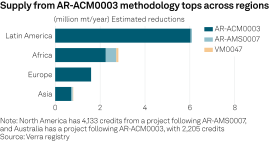
India has traditionally been a significant supplier of avoidance-based offsets and is increasingly positioning itself as a supplier of nature-based removal credits. According to registry data, India currently accounts for around 65% of the nature-based removal credit supply from Asia.
Developing avoided deforestation projects, also known as REDD+, remains challenging in India, as much of the country's forest land is government-owned, limiting private-sector participation. As a result, developers are focusing on alternative nature-based removal pathways such as afforestation and agroforestry.
"Continued issuance is expected from established REDD+ methodologies such as VM0047, as well as AR-AMS0003 projects that trace back to the CDM era, which still represent a meaningful share of available supply in Asia," Manish Dabkara, chairman and managing director at EKI Energy Services, told Platts.
Dabkara said these projects have long monitoring histories, which is one reason they continue to feature prominently in issuance volumes.
Platts assessed the Natural Carbon Capture current year price at $14.25/mtCO2e on March 19.
Lower VM0047 issuances lag demand
Traders and developers in India and Singaporesaid the limited availability of credits under Verra's VM0047 methodology has contributed to the current supply gap.
The methodology applies stricter carbon accounting rules and is perceived to generate credits with higher integrity. Hence, it is expected to result in fewer issued credits than older CDM methodologies, developers, and trader sources said.
Buyers are particularly keen to procure VM0047 credits as the Integrity Council for the Voluntary Carbon Market approved the methodology for its Core Carbon Principles label in December 2024.
In 2026 so far, credits equivalent to estimated annual reductions of 116,905 mtCO2e have been issued under the Verra registry from eight projects in India following CDM methodologies, including AR-ACM0003 and AR-AMS0007, according to data available on Verra's website. Only one project from India following the newer VM0047 methodology has issued credits, totaling 3,968 mtCO2e in February.
With additional issuances from CDM-based projects expected in the coming months, developers said the near-term supply of nature-based removal credits from India is likely to increase.
However, as older methodologies such as AR-ACM0003 are phased out and replaced by VM0047, four developers based in India said theyexpect VM0047-based credits to be unlikely to be available in significant volumes until 2028.
Since demand outpaces supply, developers expect a price premium to compensate for constrained availability in the near term.
"There's not enough ARR supply from India... I'm sure we should be able to charge a premium," an India-based developer told Platts.
Buyers seek latest VM0047 vintages
A major reason buyers increasingly turn to nature-based removals is the scarcity of high-quality REDD+ credits, which has pushed REDD+ credits prices toward parity with nature-based removal credits, according to Singapore-based traders.
While Indonesia's flagship REDD+ Katingan Mentaya credits with vintage 2020 are priced at $11.90/mtCO2e, the existing afforestation credits in supply from India are indicatively valued at $10-$15/mtCO2e.
Despite the availability of CDM-based issuances, demand is increasingly concentrated on credits generated under the VM0047 methodology, particularly for vintages from 2025 onward, according to an Indonesia-based intermediary source and an India-based developer/trader.
The Indonesia-based intermediary described such credits as "impossible" to source in the spot market, considering only four projects globally -- India, Philippines, Burkina Faso, and Ghana -- have issued credits under the methodology to date.
Dr. Leonardo Sáenz, technical manager at Permian Global, said the perception of CDM-based credits among some buyers continues to be influenced by concerns around earlier projects that used technological approaches such as non-conventional renewable energy, methane capture, industrial gas destruction, and energy efficiency.
Many of these project types have been excluded from eligibility in voluntary carbon markets after 2016, contributing to broader quality concerns, Sáenz said in a report released on March 19.
"Mature credits from nature-based solutions cannot be directly compared to credits generated from other technologies, such as those based on common technical solutions within the CDM system," Sáenz said in the report.
Ratings still a key marker
Procurement of nature-based credits since early 2025 has been driven by third-party ratings assigned to projects based on permanence, additionality, and climate impact.
Developers of CDM-based afforestation projects are considering third-party ratings to enhance credibility and attract buyers, two India-based developers said.
A Singapore-based trader said ratings have become a key requirement for buyers, a trend that gained momentum in early 2025 and has since begun to influence pricing.
For nature-based removal projects, buyers are seeking ratings of B and above, while for avoidance projects, a threshold of BBB and above is often required, market participants said.
Developers added that obtaining ratings can increase project costs by $20,000-$50,000, which can sometimes be negotiated to be sponsored by the buyer, a developer source said.
"[Pricing can increase] probably 10% or so... but depending on the rating, of course," the source said. "For someone who wants only VM0047 credits, forward deals are the only way."
While buyer expectations for VM0047 credits with delivery timelines of 2028-2030 are around $20-$25/mtCO2e, developers are pegging offers in the range of $30-$35/mtCO2e, depending on volumes and contract terms.
