Fertilizers, Chemicals, Energy Transition, Renewables, Hydrogen
March 19, 2026
FEATURE: Chile’s green hydrogen ambitions face skepticism amid delays and high costs
Editor:
HIGHLIGHTS
Chile's green hydrogen projects face delays
Production costs at $4.50/kg hinder growth
Experts doubt exports before 2050 timeline
Chilean experts and companies expressed skepticism about the country's nascent green hydrogen sector, just a few days after the government released an update to its strategy for the sector over the next few years.
Flagship projects in the sector have been canceled, with companies scaling back investments amid technological and logistical bottlenecks.
"The technology to produce green hydrogen at a scale simply doesn't exist today," Bettina Horst, executive director of Chilean think tank LYD, said.
Early in March, a committee led by the departing Gabriel Boric government published a strategy aiming to position Chile as a global exporter of green hydrogen. One of the goals is to export 300,000-700,000 mt/year of hydrogen by 2035, with total production reaching 2 to 3.5 million mt/year by 2050.
Horst, who was named to the commission that discussed the country's green hydrogen strategy in 2023, believes high costs are a major obstacle.
Moreover, the lack of existing infrastructure could block the country's ambitions. "Currently, we don't have any port that could handle large volumes of green hydrogen," said Eduardo Pérez, founder of Chilean risk consulting firm Scientiis.
Ambitious plans
The green hydrogen plan was launched in 2020, with targets already considered too ambitious, including a goal of reaching 5 GW of electrolysis capacity by 2025. It was revised in 2024, with a shift toward domestic consumption and an extension of horizons until 2060.
Successive governments bet that the country's strong renewable generation capacity could be a comparative advantage.
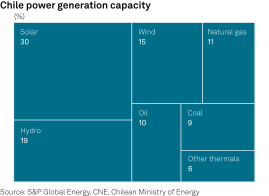
Chile generated around 87 TWh of electricity in 2025, with solar and wind accounting for around 38% of total supply, according to S&P Global Energy analysts. When combined with hydropower and other clean sources, renewables supplied nearly two-thirds of generation, the analysts said.
But a renewable matrix may not be enough to sustain such a complex sector. The current production costs for green hydrogen in Chile are $4.50/kg; the most recent strategy update forecasts them at less than $1.50/kg by 2030, Pérez said.
Besides the high cost of electrolysis, transporting liquid hydrogen is complex and costly, as its low density means it requires large volumes to generate energy. So far, the technology is only viable when produced close to end users.
Ammonia as an alternative
A possible solution would be to convert hydrogen into ammonia using the existing logistical chain from the fertilizers and explosives industries, but other challenges would arise.
"Ammonia is indeed comparatively easier to transport, but it requires a lot of energy to produce," Pérez said. "The double conversion, first from hydrogen to ammonia and then back to hydrogen, would eat up a large part of the fuel's energy efficiency," he added.
A possible offtaker for hydrogen in Chile is the explosives producer Enaex. The company purchased 370,000 mt of fossil-based ammonia in 2025, mainly from Trinidad and Tobago, but could go green. Enaex and energy group Engie proposed a full-scale 2 GW electrolyzer under the HyEx project that could produce up to 700,000 mt of green ammonia per year – enough to cover Enaex's needs and create room for exports.
It was announced in 2023, but no final investment decision was made.
"Current market conditions do not provide the competitiveness needed to develop a local production in Chile," Enaex told Platts.
Due to these issues, the company is focusing on developing low-carbon ammonia at its plant in Cachimayo, Peru, to supply its Chilean operations.
Chile also faces price swings in the international market. Total ammonia import costs in 2025 were $189.5 million, compared to $417 million in 2022, according to data from the S&P Global Trade Atlas, when war in Ukraine disrupted global energy and ammonia markets. Prices have also increased again due to the Middle East war.
Platts assessed FOB Black Sea ammonia at $40.13/MMBTU on March 18, compared with $30.47/MMBTU on Jan. 2. The assessment is also up from $27.85 in its launch, on Jan. 10, 2025.
More roadblocks
In January, AES decided to cancel its INNA green hydrogen and ammonia project in Chile's northern Antofagasta region, which was planned to produce around 200,000 mt of hydrogen and 116,000 mt of green ammonia per year.
In the southern Magallanes region, previously considered a potential green hydrogen hub due to its wind power capacity, the local association H2V Magallanes has suspended activities after some of its main associates withdrew from the market. H2V Magallanes did not respond to Platts' requests for comments.
Policy makers have also been targeting the mining industry as a potential client, but costs remain an issue. "The Chilean mining industry is competitive and globally integrated, and it won't adopt green hydrogen massively unless costs get closer to conventional alternatives," Pérez said.
In a more realistic view, he expects production to remain restricted to pilot plants or niche applications in the next few years.
According to Horst, the scaling back of green hydrogen reflects a wider change in businesses' priorities. "Global investments are shifting towards artificial intelligence and datacenters, and Chile should adapt to it," she said.
Platts is a part of S&P Global Energy.
