Energy Transition, Natural Gas, Emissions, Carbon
March 17, 2026
EU carbon market softening as supply balancing rules face heightened scrutiny

HIGHLIGHTS
Von der Leyen pushes for reform ahead of Q3 review
MSR changes could add 42 million allowances in 2026
Analysts also consider flexibility buffer, free allocation changes
The EU's cap-and-trade carbon market, which sets a price on greenhouse gas emissions within the bloc, is set to undergo a policy review in the third quarter of this year, which will define the future direction of Europe's climate framework.
Against this backdrop, multiple politicians have been calling for reforms to the flagship scheme. This has led to a sharp drop in the price of EU Allowances, which hit an 11-month low of Eur65.06/metric ton of CO2 equivalent ($75/mtCO2e) during March 17 trading, according to the Intercontinental Exchange.
Compounding the bearish effect from the policy side, the outbreak of war in the Middle East has added uncertainty to the energy market. Prices have surged across commodities, with gas up 50% and oil around 40% higher compared to pre-crisis levels. The surge in gas prices has pushed coal into profitable territory over gas in the power generation mix, supporting demand for allowances.
Market watchers expect the upcoming market review and ongoing supply dynamics resulting from the war to keep carbon prices rangebound over the coming weeks, but a prolonged Middle East conflict could force allowances to spill in either direction. There are also growing expectations that the European Commission will trigger policy levers ahead of the review, potentially affecting supply balances earlier than scheduled.
EU ETS reforms
In a March 16 letter seen by Platts, EC President Ursula von der Leyen said that a proposal would be put forward to increase "the firepower of the Market Stability Reserve, so that it can more effectively address excessive price volatility and keep prices in check in the short term."
Tweaks to MSR intake rates and thresholds are also on the agenda for the Q3 review, with a report on the reserve due by the end of this year. But the MSR is a distinct legal act from the EU ETS directive, meaning it may be amended separately, which could help streamline the process.
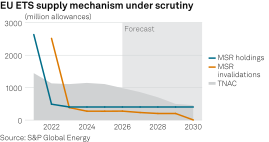
Under current rules, when the Total Number of Allowances in Circulation (TNAC) exceeds 833 million, the ETS triggers a tightening mechanism. Each year, 24% of TNAC is withheld from scheduled auctions and placed into the MSR.

Changes to the MSR could mean this rate gets lowered from 24% to 12%, which would materially increase supply in the EU ETS over September to December 2026, Danylo Babkov, carbon analyst at S&P Global Energy Horizons, said.
"Current estimates indicate this adjustment would release approximately 42 million EUAs into the market at the end of 2026 alone. Relative to baseline auction volumes, this corresponds to an increase in available supply of roughly 18%-19%," Babkov said.
Meanwhile, analysts at Carbon Insights modelled three potential policy measures, including changes to the flexibility buffer, changes to the MSR intake and adjustments to free allocations and the Carbon Border Adjustment Mechanism (CBAM).
"If the full package materialized as modelled, it would add 145 [million metric tons] to the TNAC [in 2028] -- [this would be] bearish for price at any reasonable sensitivity estimate," said Stefan Kermer, founder of analytics company Carbon Insights. "The MSR at 12% is the key element. It adds supply and weakens the absorption mechanism simultaneously."
The quickest way to implement a change would be to use the flexibility buffer under Article 10a5a of the ETS directive, which holds around 260 million mt and could be enacted by September 2026, according to Kermer.
Von der Leyen further noted in her letter that work on the upcoming ETS revision would be accelerated. While the commission has not yet put forward any official reform variants, some workable options have been suggested.
The former director general of the commission's climate department, known for his involvement in designing the EU ETS, Jos Delbeke, previously recommended using the existing 3% free allocation buffer to kick-start the operations of the upcoming Industrial Decarbonisation Bank to help address EU competitiveness.
Another existing proposal has received support from key lawmaker Peter Liese of the European People's Party. This approach suggested reducing the current linear reduction factor -- which determines the annual decrease in the EU ETS cap -- from 4.4% to 3.4%, adding up to 88 million mt/year to the current cap from 2029 onward.
Benchmarks
Ursula von der Leyen further noted that the EC would "shortly adopt" the updated EU ETS benchmarks.
"The release of the EU ETS Phase 4 AP2 (2026-2030) benchmarks is the most immediate lever the commission could pull to impact price," Sawal Bacha, research associate at Redshaw Advisors, told Platts.
Benchmarks are sector-dependent values under the EU ETS that determine the share of free allowances allocated to industrial facilities based on their emissions intensity relative to the most efficient producers.
"The benchmarks are expected to be less stringent than previously anticipated, which would increase free allocation in AP2 and ease EU producers' hedging requirements," Bacha said.
A draft presentation previously seen by Platts, part of S&P Global Energy, suggested a less aggressive reduction in free allocations for chemicals and cement facilities, while those for steel and refining were suggested to remain stable.

Editor: